

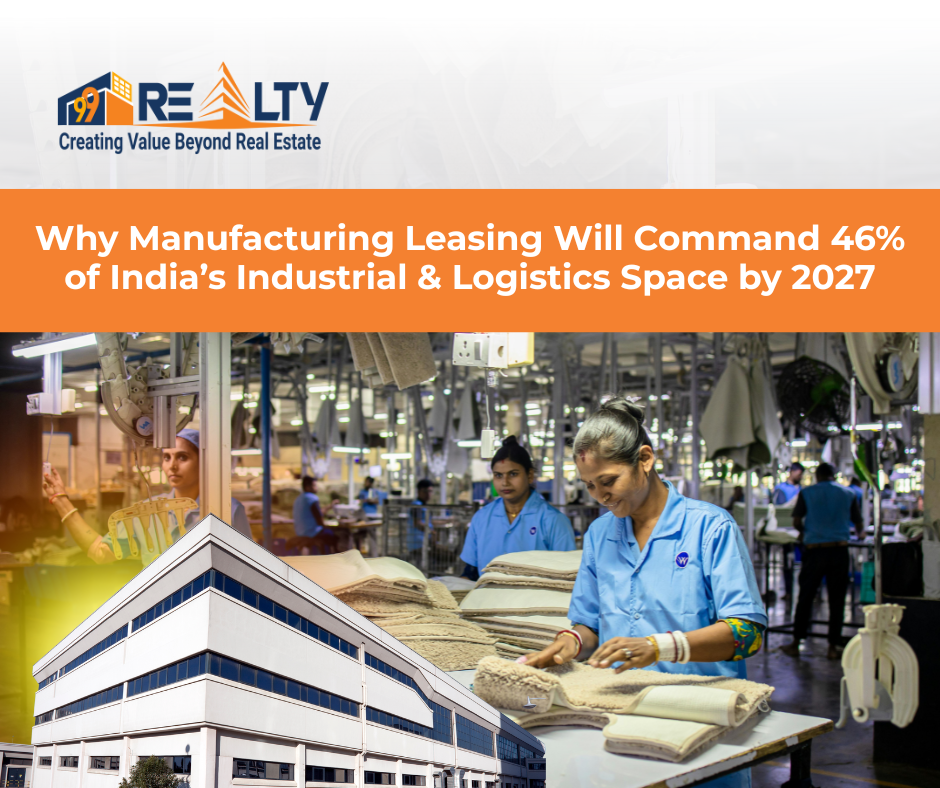
India is experiencing a manufacturing moment unlike anything seen in the last 30 years. The combination of Make in India, PLI schemes, record FDI inflows, China+1 diversification, and world-class logistics infrastructure is reshaping the country’s industrial landscape.
Walk through any major Indian industrial corridor today and you’ll feel it in the air — a quiet but unmistakable electricity. Warehouses that once stored FMCG cartons now hum with precision machines. Massive sheds rise where empty plots stood a year ago. Long convoys of trucks line the new expressways, carrying everything from smartphone motherboards to EV batteries. What was once logistical infrastructure has become the backbone of India’s manufacturing renaissance.
And at the center of this shift lies one of the most powerful real estate trends of the decade:
Manufacturing leasing in India is projected to surge to 46% of the entire industrial & logistics market by 2027.
For the industrial property market, this is not just growth — it is redefinition.
For investors, it is a once-in-a-generation window.
And for India, it is a turning point.
Infra-Revolution: Unlock Your Fortune in India’s Property Apex!
The Great Shift: From Warehouses to Workshops
For nearly a decade, India’s industrial leasing narrative was dominated by warehousing. E-commerce giants like Amazon, Flipkart etc ruled the demand charts. FMCG companies expanded distribution networks. Logistics became the standard plotline.
But after 2020, the story flipped.
Manufacturing stepped into the spotlight — and in a big way.
Why the sudden shift?
Because the world changed.
Pandemics exposed supply-chain vulnerabilities.
Geopolitics redrew manufacturing routes.
Companies began asking one question:
“What’s our plan beyond China?”
India became the answer — not slowly, but with a force.
China+1 Becomes China+ Now
If global boardrooms had a map pinned on the wall, India’s industrial corridors would be glowing. Noida for electronics. Hosur for EVs. Sanand (Gujrat) for automotive. Chakan (Maharastra) for engineering. Bengaluru (Karnataka) for chips and hardware.
The China+1 strategy wasn’t just a hedge — it became a necessity.
The “China Plus One” strategy is a business approach for companies to diversify their supply chains by investing in countries in addition to China, rather than solely relying on China for manufacturing.
Multinationals no longer wanted another manufacturing base.
They wanted a long-term alternative.
India offered:
- A massive, skilled workforce
- Political and economic stability
- Huge domestic consumption
- Government incentives
- A rapidly improving logistics backbone
Companies like Foxconn, Samsung, MG Motors, and Tata Electronics began expanding footprints with unprecedented speed.
This mobility triggered a rising appetite for Grade-A industrial real estate.
PLI & Make in India: The Fuel Behind the Boom
If China+1 lit the spark, PLI (Production Linked Incentive) poured fuel on the fire.
A Production Linked Incentive (PLI) scheme provides financial rewards to companies for incremental sales of goods manufactured in India, encouraging domestic production, attracting investment, boosting exports, and reducing import dependence, especially in strategic sectors like electronics, auto, pharma, and solar, as part of India’s ‘Atmanirbhar Bharat’ initiative.
Smart Property Investment Tips 2026: How to Create a Strong Real Estate Portfolio in India
India has announced ₹2.4 lakh crore+ in PLI schemes across 14 sectors, including:
- Electronics
- Semiconductors
- EVs & batteries
- Pharma
- White goods
- Food processing
- Telecom
These incentives did something that the industry had long waited for:
They made manufacturing financially irresistible.
For real estate, this meant:
- Bigger plants
- Faster expansions
- More vendor ecosystems
- Continuous demand for Grade-A industrial facilities
As one industrial developer put it:
“We’re not just building sheds anymore. We’re building factories of the future.”
India’s New Logistics Backbone: The Silent Enabler
Drive along the Delhi–Mumbai Expressway or the Bengaluru–Chennai corridor and you see something extraordinary — speed, scale, and connectivity that rivals global standards.
In just 5 years, India built:
- Multi Modal Logistics Parks
- Dedicated Freight Corridors
- High-speed expressways
- Modern ports
- Warehousing zones
- Rail connectivity to industrial hubs
This infrastructure didn’t just reduce shipping time — it changed the economics of manufacturing.
A truck that once took 24 hours to reach a port now does it in 13.
Factories can run tighter scheduling.
Suppliers can cluster nearby.
Leasing demand skyrocketed.
Domestic Consumption Is Rising, Creating Two-Way Demand
India will add 230 million new middle-class consumers by 2030.
This creates:
- More demand for electronics
- More mobility (EV)
- More FMCG goods
- More pharmaceuticals
Manufacturers must expand plant footprint to serve Bharat.
India’s Industrial & Logistics Market: 2024 → 2027 Upgrade
Here’s what real estate stakeholders must know:
| Year | Total Industrial & Logistics Leasing | Manufacturing’s Share |
|---|---|---|
| 2023 | ~44–46 million sq. ft | 28–30% |
| 2024 | ~50–55 million sq. ft (projected) | 32–34% |
| 2027 | ~70–75 million sq. ft (projected) | 46% |
That means almost HALF of all industrial space leased in India in 2027 will be manufacturing-driven.
This shift is historic.
Who Will Drive Manufacturing Leasing Growth? (Sector Ranking)
Here’s the manufacturing hierarchy shaping industrial real estate:
1. Electronics & Semiconductors (Fastest growing)
- Smartphone assembly
- Components
- Chip packaging & testing (OSAT)
- Data center equipment manufacturing
2. Electric Vehicles & Auto Components
- Battery pack assembly
- EV motors
- Power electronics
- Charging equipment supply lines
3. FMCG & Food Processing
- Cold chain
- Automated warehousing
- Distribution hubs
4. Pharma & MedTech
- Bulk drug manufacturing
- Medical devices
- R&D facilities
5. Renewable & Energy Components
- Solar modules
- Inverters
- Green hydrogen components (evolving)
Each sector demands different types of industrial spaces—from clean rooms to heavy-floor-load manufacturing sheds—boosting built-to-suit (BTS) leasing. BTS leasing is growing at 25–30% annually and will dominate by 2027.
Built-to-Suit (BTS): The Real Estate Format That Will Explode
Manufacturers don’t want old, outdated sheds.
They want:
- Mezzanine floors
- 12–14m clear height
- Long-term lease stability
- Floor load capacity for heavy machinery
- Fire & safety compliance
- 24/7 power supply backup
- Sustainability certifications (ESG)
So what are they choosing?
Built-to-Suit (BTS) leasing is growing at 25–30% annually.
This means developers who offer customized industrial parks will win the next decade.
Why Manufacturing Tenants Are the Best Real Estate Clients
Manufacturers are unlike e-commerce or 3PL tenants.
They bring:
- Longer lease terms (9–15 years)
- Higher lock-ins (3–7 years)
- Steady rental escalations
- Large capex commitment
- More stable operations
Their factories aren’t plug-and-play; they’re custom-built.
They don’t move easily.
They don’t churn like warehouse tenants.
For developers, this means:
- Zero vacancy risks
- Predictable cash flows
- Better valuation
- Stronger bankability
For investors, it means:
- Higher yields (8–11%)
- Longer stability
- Stronger tenant stickiness
This is why the smartest developers today are shifting from:
“Warehouses for storage” → “Factories for production.”
Real Estate Investor’s Goldmine: Why Industrial Is the New King
Industrial real estate is quietly outperforming residential + retail combined.
Here’s what the some investors know that others don’t:
1. Rental yields are unmatched
- Industrial: 7–11%
- Retail: 5–7%
- Residential: 2–3%
2. Lease tenures are 2x longer
A manufacturer’s factory is not temporary — it’s a commitment.
3. Escalations are better
Typical increments:
- 5% yearly
- or 15% every 3 years
4. Land appreciation is explosive
Land in:
- Bhiwandi
- Sanand
- Sriperumbudur
- Chakan
- Noida Phase 2
- Dholera
has appreciated 60–150% in 5 years.
5. REIT future = Multi-bagger potential
Industrial REITs are coming.
Early investors will get the biggest upside.
The Headwinds: Balanced Perspective for Serious Readers
To keep this balanced and credible, here are the risks:
1. Environmental clearance delays
Many manufacturing parks face approval backlogs.
2. Infrastructure inconsistencies across states
Some regions still have power and logistics gaps.
3. Customization cost overruns
BTS can become expensive without proper planning.
4. Skilled labour shortages
Despite India’s youth, skilled manufacturing labour is not evenly distributed.
5. Policy inconsistency
State-level tax or policy changes can impact leasing.
But these challenges are manageable—and far outweighed by the growth opportunity.
Conclusion
The projection that manufacturing will make up 46% of India’s industrial leasing by 2027 is more than a statistic. It’s the strongest signal yet that industrial real estate is entering its biggest boom cycle.
For — developers, investors, brokers, and landowners — this is the moment to act.
Industrial is becoming the most secure, profitable, future-proof real estate asset class in India. Those who position themselves now will ride a decade-long wave of:
- capital appreciation
- high rental income
- global tenant demand
- infrastructure-driven land growth
The industrial revolution of India is here.
The real estate revolution is riding on top of it.
Disclaimer : The information provided in this article is based on publicly available data, industry reports, and independent research. While 99Realty strives to ensure accuracy and reliability, we do not guarantee the completeness, timeliness, or absolute accuracy of the content. All insights, forecasts, and opinions expressed are for informational and educational purposes only and should not be considered financial, investment, or legal advice.
Need Help?
Need help evaluating a property or planning your next move in the market?
Reach out to 99 REALTY – your trusted real estate partner for smarter choices.
Subscribe to get updates on our latest posts and market trends.

Join The Discussion