

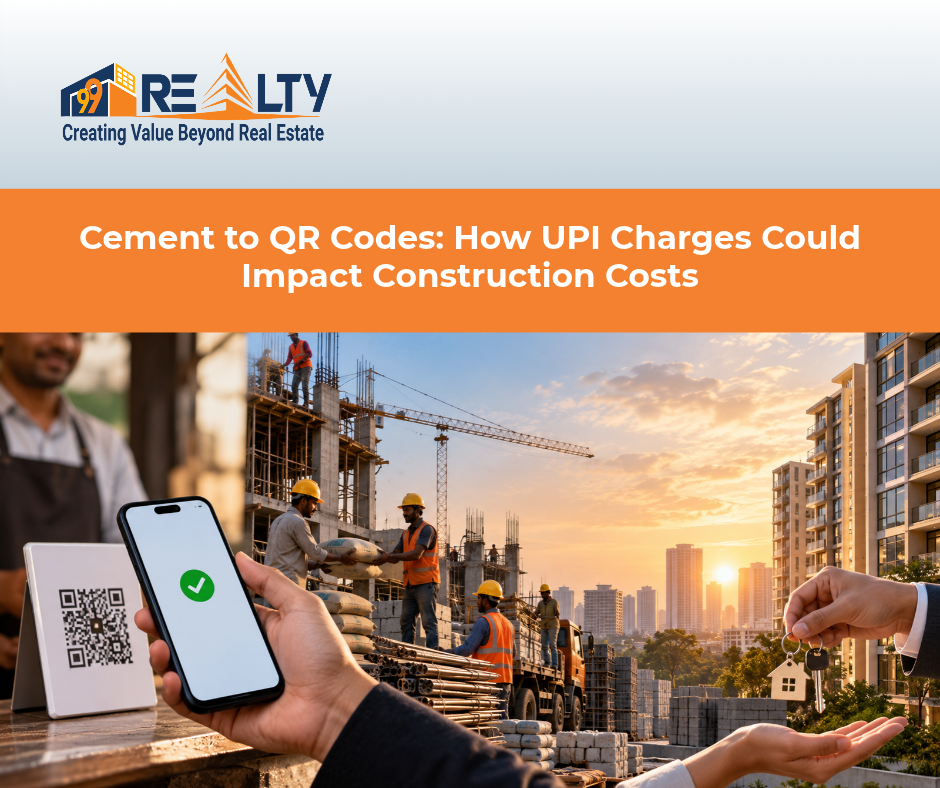
From property bookings and developer collections to cement, steel, suppliers and contractors, India’s real estate ecosystem runs on thousands of payments. As a new 0.4% MDR applies to specified high-value UPI merchant transactions, the bigger question is not whether homebuyers will pay more—but whether the cost of moving money through the construction ecosystem will eventually find its way into property prices.
India’s real estate industry has been going digital one payment at a time.
A homebuyer scans a QR code to pay a booking amount. A developer receives an instalment. A contractor settles an invoice. A supplier gets paid for steel or tiles. A labour contractor receives money for a month’s work.
Behind every building is a payment chain.
And now, that chain is entering a new phase.
Under the new UPI framework, a 0.4% Merchant Discount Rate (MDR) will apply to specified person-to-merchant (P2M) transactions above ₹2,000, with the MDR capped at ₹300 per transaction for payments of ₹75,000 and above. Person-to-person transactions remain free, while payments up to ₹2,000 and transactions covered by the zero-MDR framework for small merchants also remain free. The government estimates that around 96% of P2M transactions will remain unaffected.
The change raises an intriguing question for real estate:
If builders, contractors and suppliers increasingly use digital payments throughout the construction process, could the new cost of certain UPI transactions eventually add to the cost of building a home?
The answer is not a simple yes or no.
Can Blockchain Is The Best Way To End India’s Property Chaos?
UPI Is No Longer Just a Payment App
The scale of India’s UPI ecosystem explains why even a small change in its economics matters.
According to NPCI, UPI processed 24.51 billion transactions worth ₹29.82 lakh crore in August 2026. That translates into roughly 24.5 billion individual transactions in a single month.
What began as a convenient way to transfer money between individuals has become part of the country’s commercial infrastructure.
Real estate is increasingly part of that transformation. But property transactions are different from everyday retail payments.
A grocery purchase might be ₹500.
A construction-material invoice could be ₹50,000, ₹1 lakh or several lakh rupees.
That is where the new MDR becomes relevant.
Follow the Money: From Developer to Building
Consider what actually happens when a residential project is constructed.
A developer doesn’t simply pay a single contractor and wait for the building to appear.
There can be a long chain:
Developer → Contractor → Material Supplier → Distributor
And alongside it:
Developer/Contractor → Labour Contractor → Workers
Then there are payments to electricians, plumbers, fabricators, transporters, architects, interior contractors and numerous other service providers.
The impact of UPI MDR will therefore depend heavily on who is receiving the money and how the transaction is classified.
Paying the Supplier
Suppose a developer pays a construction-material supplier ₹50,000 through an eligible UPI merchant transaction.
At 0.4%, the MDR would be ₹200.
If the applicable MDR attracts 18% GST, the GST on ₹200 would be ₹36, taking the immediate payment-related outlay to ₹236, subject to the business’s GST treatment and eligibility for input tax credit.
Now consider a ₹1 lakh payment.
A straightforward 0.4% calculation would produce ₹400. But the new framework caps the MDR at ₹300 for transactions of ₹75,000 and above.
So the MDR on that ₹1 lakh transaction would be capped at ₹300 rather than continuing to rise with the transaction value.
That distinction is crucial for construction.
A developer cannot simply take a ₹10-crore project and assume that 0.4%—or 0.472% after GST—will automatically be added to the entire construction cost.
The actual impact depends on the number, size and type of eligible transactions.
What About the Labourers?
This is where the story becomes even more nuanced.
Construction sites employ large numbers of workers, but labour payments can be structured in different ways.
If a builder or contractor pays an individual worker through a genuine person-to-person UPI transaction, the new MDR does not apply simply because the payment is above ₹2,000.
The government has explicitly stated that all P2P UPI transactions will remain free regardless of transaction value.
But the situation can change when the payment goes to a labour contractor, manpower agency or other business.
A payment from a developer to a business can fall into the P2M category, meaning the applicable MDR rules may come into play.
So, broadly:
Builder → individual worker: P2P; remains free.
Builder → labour contractor/business: potentially subject to MDR if it is an eligible P2M transaction.
Builder → steel/cement/tile supplier: potentially subject to MDR if the payment qualifies.
That distinction prevents the new framework from being interpreted as a blanket charge on every rupee spent on construction.
The ₹300 Cap Changes the Calculation
There is another reason the impact may be smaller than the headline 0.4% suggests.
For eligible transactions of ₹75,000 and above, the MDR is capped at ₹300 per transaction.
Consider three hypothetical payments:
- ₹50,000 → MDR at 0.4% = ₹200
- ₹1,00,000 → MDR capped at ₹300
- ₹5,00,000 → MDR capped at ₹300
The effective MDR therefore falls as the transaction value increases beyond the cap.
For a ₹5-lakh payment, ₹300 represents just 0.06% of the transaction value.
That makes one thing clear:
The number of transactions may matter more than the headline size of the construction project.
Could This Make Construction More Expensive?
Potentially—but indirectly.
Imagine a developer has a ₹10-crore construction project.
It would be misleading to simply calculate:
₹10 crore × 0.4% = ₹4 lakh
and call that the additional cost.
Why?
Because not every payment will be made through UPI.
Not every UPI payment is a merchant transaction.
Not every merchant transaction exceeds ₹2,000.
Small merchants covered by the zero-MDR framework remain protected.
P2P transactions remain free.
And large eligible transactions are subject to the ₹300 cap.
The more realistic question is:
How many eligible UPI merchant transactions are actually flowing through the project’s payment chain?
For a large developer making hundreds or thousands of supplier and contractor payments, the cumulative cost could become noticeable.
For a smaller project relying mainly on bank transfers, cheques or direct P2P payments, the effect could be considerably smaller.
The Supplier Could Become the Pressure Point
The biggest indirect impact may occur away from the developer. Take a steel supplier supplying multiple construction projects. The supplier may receive dozens of high-value payments every month from builders and contractors. Similarly, a tile distributor, electrical supplier or plumbing-material dealer may process hundreds of merchant transactions. Even if each individual MDR is relatively small, repeated payments create a recurring operating expense. Businesses then have several choices.
They can absorb the cost.
They can encourage customers to use bank transfers for certain high-value payments.
They can change their collection systems.
Or they can factor payment-processing expenses into their broader operating economics.
That does not automatically mean a supplier will increase the price of cement, steel or tiles.
But it creates another cost that businesses have to account for.
And in construction, where thousands of individual transactions eventually become the cost of a building, small expenses can accumulate.
Will Homebuyers Ultimately Pay More?
That is the part that requires caution.
The new MDR alone is unlikely to suddenly add a visible percentage to property prices.
Real estate prices are influenced by far larger factors, including land costs, construction materials, labour, financing, approvals, taxes, logistics and market demand.
The new UPI framework is therefore unlikely to become a standalone driver of housing inflation.
Its impact is more likely to be incremental.
A developer may have slightly higher payment-processing costs.
A contractor may reconsider how certain invoices are settled.
A supplier may change its preferred payment channel.
A business that cannot recover or claim certain tax components may face a slightly higher effective cost.
Over time, those costs could become part of the broader operating economics of construction.
But that is very different from saying:
“UPI charges will make homes 0.4% more expensive.”
There is no basis for making that blanket claim.
And It Isn’t a “UPI Tax”
One distinction is particularly important.
The new MDR should not be described as a tax on UPI.
The government has explicitly clarified that MDR is neither a tax nor a charge collected by the government or NPCI. It is distributed among participants in the payment ecosystem, including banks and payment-application providers.
Customers also are not supposed to be directly charged MDR.
The government has stated that banks should ensure merchants do not pass MDR on to customers.
For businesses, however, GST treatment remains relevant because the MDR is a service-related charge. The ultimate cost can depend on whether the business is GST-registered and eligible to claim input tax credit.
That means the real accounting impact can differ from one participant in the construction chain to another.
A New Payment Strategy for Real Estate?
The new framework could ultimately make developers and contractors more conscious of which payment method they use for which transaction.
UPI may remain attractive for convenience, speed and reconciliation.
Bank transfers may become more attractive for selected high-value settlements.
P2P UPI will continue to make sense for eligible individual payments.
And small merchants remain protected by the zero-MDR provisions.
Rather than abandoning UPI, the construction industry could simply become more selective about how it uses it.
That would represent an interesting evolution.
India’s digital-payment revolution was initially about making payments easier.
The next phase may be about making them economically efficient as well.
The Bigger Picture for Real Estate
The most important part of this story may not be the 0.4% figure at all.
It is what happens when a digital payment system becomes deeply embedded in an industry where transactions happen at every stage of production.
A building is not created by one transaction.
It is created through thousands of payments—to suppliers, contractors, workers, transporters, service providers and eventually the developer.
If even a fraction of those payments carry a new processing cost, the industry will notice.
But the effect is likely to be measured in operating efficiency and payment strategy, rather than an immediate jump in property prices.
For homebuyers, the change is unlikely to transform the cost of purchasing a home overnight.
For developers and contractors, however, it may encourage a closer look at payment flows.
And for suppliers, who sit at the heart of the construction chain, it could make the economics of digital collections more important than ever.
The Bottom Line
UPI’s new MDR is unlikely to make homes suddenly 0.4% more expensive.
But it could introduce a small new cost into parts of the construction and real-estate payment ecosystem.
The real impact will depend on transaction volume, merchant classification, payment size, the ₹300 cap, GST treatment and the proportion of construction payments actually routed through eligible UPI merchant transactions.
In other words, the story isn’t simply about UPI and the homebuyer.
It is about UPI and everything that happens before the homebuyer receives the keys.
From the steel supplier to the labour contractor, from the developer to the distributor, India’s construction industry is built on a vast network of payments.
And as digital payments evolve from a convenience into core financial infrastructure, the cost of moving money could become another line in the construction ledger.
Disclaimer: This article is for informational and educational purposes only. UPI charges, MDR rules, GST treatment and related regulations may change. Readers and businesses should verify the latest applicable guidelines before making financial or business decisions.
Need Help?
Need help evaluating a property or planning your next move in the market?
Reach out to 99 REALTY – your trusted real estate partner for smarter choices.
Subscribe to get updates on our latest posts and market trends.



Join The Discussion