

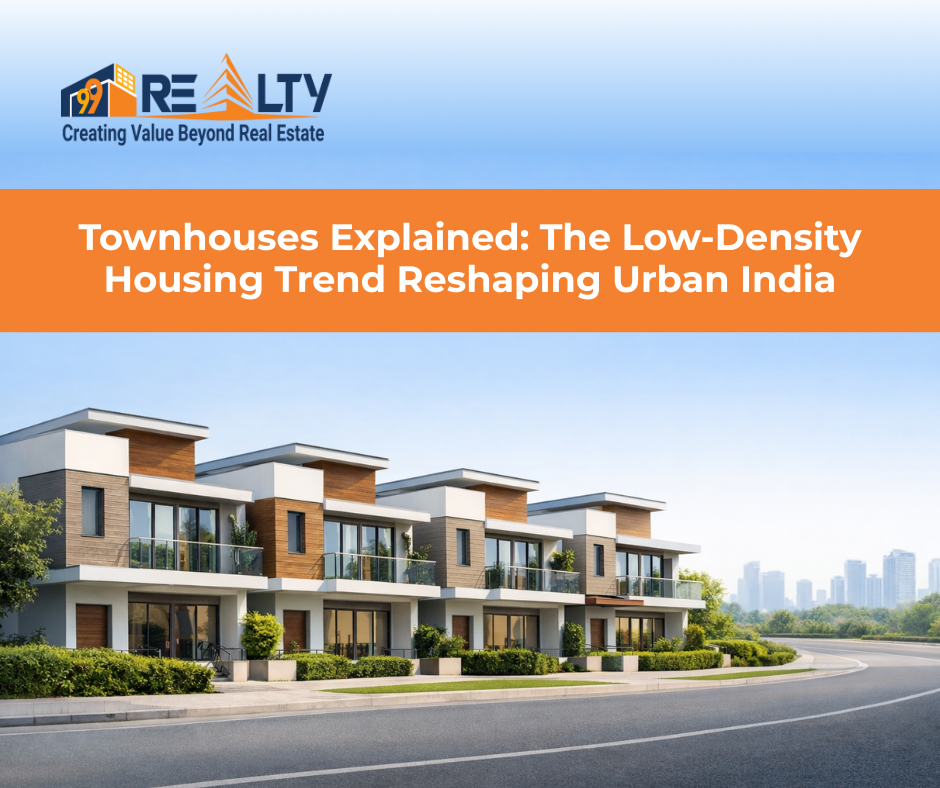
Imagine waking up in a home that feels independent, looks premium, yet doesn’t demand the budget of a sprawling bungalow. A place where you have your own entrance, multiple floors, privacy, and still enjoy the safety and facilities of a community.
That, in essence, is the charm of a townhouse.
In recent years, townhouses—often called row houses in India—have quietly become one of the most attractive housing options for urban Indians. From IT professionals and young families to NRIs and investors, more people are asking the same question:
“Is a townhouse the perfect middle ground between an apartment and a villa?”
Let’s break it down—clearly, creatively, and practically—so you know exactly whether a townhouse is right for you.
Villa vs Apartment: How to Pick the Right Investment Option?
What Is a Townhouse?
A townhouse is a multi-storey residential unit that shares one or more side walls with neighboring homes but has its own private entrance. Unlike apartments, townhouses are usually ground-up homes—meaning you own the space across floors, not just a single flat in a vertical building.
In India, townhouses are commonly known as:
- Row houses
- Cluster homes
- Urban villas (in premium projects)
They are most often found inside gated communities with shared amenities like parks, clubhouses, security, and internal roads.
The Origin of Townhouses: Where Did the Concept Come From?
The concept of a townhouse did not originate in India. Its roots go back several centuries to Europe, particularly England and parts of Western Europe, before evolving further in the United States.
Early European Roots (17th–18th Century)
Townhouses first appeared in British and European cities during the 17th and 18th centuries.
- Wealthy aristocratic families who owned large country estates needed urban residences when they traveled to cities for:
- Parliament sessions
- Trade
- Social gatherings
- Since land inside cities was limited and expensive, homes were built side by side, sharing walls, but still maintaining:
- Separate entrances
- Multiple floors
- A sense of individual ownership
These urban homes were called “town houses”—literally meaning a house in town.
That’s where the term townhouse was born.
British Influence & Urban Planning
As British cities like London became denser:
- Townhouses became a standard urban housing model
- Rows of uniform homes lined streets—efficient, elegant, and space-saving
- This style later influenced colonial city planning
Evolution in the United States (19th–20th Century)
The concept was refined further in American cities such as:
- New York
- Boston
- Philadelphia
In the U.S., townhouses became popular because they:
- Offered individual ownership
- Allowed higher density without high-rises
- Balanced affordability and privacy
Modern American townhouses also introduced:
- Gated communities
- Shared amenities
- Planned layouts
This version strongly influenced modern Indian townhouse projects.
How Townhouses Came to India
India adopted the townhouse concept much later, mainly after:
- Liberalisation in the 1990s
- Growth of private real estate developers
- Expansion of IT hubs and urban suburbs
In India, the model was adapted and renamed as:
- Row houses
- Cluster housing
- Urban villas
Indian developers combined:
- Western townhouse design
- Indian lifestyle needs (joint families, parking, puja rooms, terraces)
The result?
A hybrid home—international in concept, Indian in execution.
Townhouse vs Apartment vs Villa (Quick Snapshot)
| Feature | Apartment | Townhouse | Villa |
|---|---|---|---|
| Floors | Single level | 2–3 floors | 1–2 floors |
| Private Entrance | ❌ | ✅ | ✅ |
| Shared Walls | Multiple sides | One or two sides | ❌ |
| Land Ownership | ❌ | Partial | ✅ |
| Cost | Lowest | Mid-range | Highest |
| Maintenance | Low | Moderate | High |
A townhouse beautifully sits between an apartment and a villa—both in lifestyle and pricing.
Benefits of Living in a Gated Society vs Standalone Apartment Building
How Townhouses Work in India
In Indian cities, townhouses are typically developed by reputed builders as part of low-density housing projects. You may find them in:
- Suburban growth corridors
- IT hubs
- Premium residential zones
Cities like Kolkata, Bengaluru, Pune, Hyderabad, Chennai, and Gurugram have seen strong demand for townhouse-style living.
Most townhouses in India come with:
- Private parking
- Front sit-out or backyard
- Internal staircase
- Community security & amenities
Why Are Townhouses Gaining Popularity in India?
1. The “Independent Home” Feeling
You don’t share lifts, corridors, or ceilings with dozens of neighbors. That alone is a massive emotional win for Indian families.
2. Space That Grows With You
With multiple floors, you can:
- Keep living space on the ground floor
- Bedrooms upstairs
- A home office, puja room, or terrace lounge on top
3. Better Privacy Than Apartments
Fewer shared walls = less noise, fewer disturbances, and more personal freedom.
4. Community Living Without High-Rise Chaos
You still get:
- Security
- Clubhouse
- Play areas
But without crowded elevators or dense towers.
Pros of Living in a Townhouse (India-Specific)
More Space Per Rupee
Compared to luxury apartments, townhouses often give larger carpet area at similar prices—especially in developing corridors.
Sense of Ownership
Indian buyers emotionally value “my own house”, and a townhouse delivers that feeling far better than a flat.
Customization Freedom
Interior changes, modular expansions, and floor-wise redesign are easier than in apartments (subject to community rules).
Better Resale & Rental Demand
Townhouses attract:
- Families
- Senior executives
- NRIs
This often translates into stable resale value and premium rentals.
Ideal for Work-From-Home Era
Separate floors make it easy to keep work and personal life apart—something flats struggle with.
Cons of Townhouses You Must Know
Higher Cost Than Apartments
Townhouses cost more upfront than flats in the same location due to land component and lower density.
Maintenance Responsibility
While societies handle common areas, internal maintenance (stairs, roof, plumbing) is more your responsibility.
Limited Supply
Unlike apartments, townhouses are not widely available in all cities or locations.
Not Always Ideal for Seniors
Multiple floors can be challenging unless there’s a bedroom on the ground floor.
Who Should Buy a Townhouse?
A townhouse is ideal if you are:
- A growing family needing space
- A professional couple planning long-term settlement
- An NRI wanting a premium yet manageable home
- Someone upgrading from an apartment but not ready for a villa
If you value privacy, space, and community living—this is your sweet spot.
Legal & Ownership Aspects in India
Before buying a townhouse, always check:
- Type of ownership (freehold preferred)
- Land share clarity
- RERA registration
- Society formation & bylaws
- Maintenance structure
Unlike apartments, townhouses involve partial land rights, so documentation clarity is crucial.
Investment Perspective: Are Townhouses a Good Bet?
From an investment lens:
- Appreciation is often better than apartments
- Rental yields are stable but niche
- Demand remains strong in IT-driven cities
They may not flip fast like small flats, but they shine as long-term wealth assets.
Townhouse vs Row House: Is There a Difference?
In India, there’s practically no difference.
“Townhouse” is a global, premium-sounding term.
“Row house” is the traditional Indian name.
Functionally and legally, they are the same.
Final Thoughts: Is a Townhouse Worth It?
If apartments feel cramped and villas feel out of reach, a townhouse is the golden middle path.
It gives you:
- Independence without isolation
- Space without excess
- Community without congestion
In a country where land is precious and lifestyles are evolving, townhouses are not just homes—they’re a smarter way to live.
Need Help?
Need help evaluating a property or planning your next move in the market?
Reach out to 99 REALTY – your trusted real estate partner for smarter choices.
Subscribe to get updates on our latest posts and market trends.


Join The Discussion