

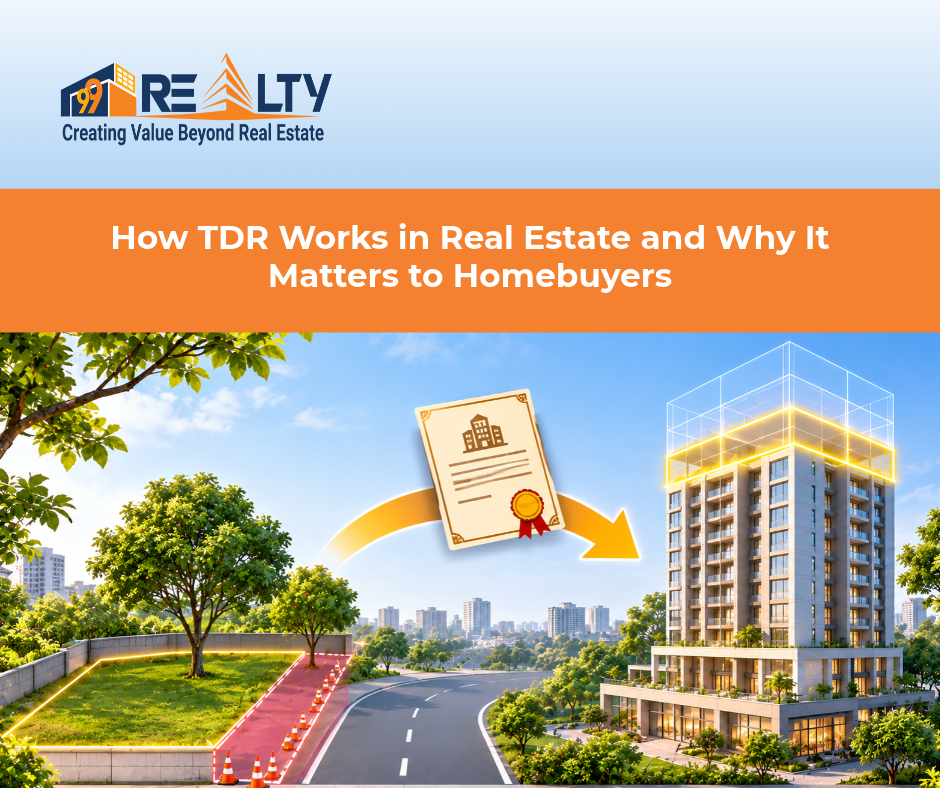
In real estate, land is not always used to its full potential simply because its owner has the land. Development is governed by rules relating to floor area, building height, setbacks, land use, road width and several other factors. Sometimes, a property owner may have to surrender a portion of land for a public purpose. In other situations, a developer may want to construct more than the basic permissible area.
This is where Transferable Development Rights (TDR) come into the picture.
TDR is one of those real estate concepts that can quietly influence the way cities grow, how developers plan projects, how landowners receive compensation and how homebuyers experience a neighbourhood. While it may sound like a technical term used only by architects, builders and urban planners, understanding TDR can help buyers make better sense of development happening around them.
So, what exactly is TDR, how does it work, and why is it becoming an important part of urban real estate development in India?
Understanding TDR: What Does It Actually Mean?
Transferable Development Rights (TDR) allow the development potential of a particular piece of land to be transferred to another plot, subject to the rules of the concerned authority.
In simple terms, imagine a landowner has a plot that is earmarked for road widening, a park, a public facility or another urban development purpose. Instead of receiving only monetary compensation in certain eligible cases, the owner may receive development rights in the form of a certificate. These rights may be used on an eligible plot or transferred to another developer who can use them to construct additional permissible built-up area.
This means the land and the right to develop it can be treated separately.
For example, a landowner may surrender a portion of land for a public road. The development potential associated with the surrendered land may be awarded as TDR. A developer elsewhere in the city may purchase those rights and, if permitted by the applicable regulations, use them to increase the permissible construction area of their project.
TDR is generally documented through a Development Rights Certificate (DRC) or a similar certificate issued by the competent authority. The exact calculation, eligibility, transferability and utilisation rules vary from city to city and state to state.
Game-Changing Real Estate Judgment: Sellers Cannot Cancel Registered Sale Deed Over Unpaid Dues
How Does TDR Work?
The process generally involves two sides of the development ecosystem: a plot where development rights are generated and another plot where those rights may be utilised.
The TDR process in simple terms
- Land is identified for a public purpose — such as road widening, a park, a public amenity or another approved requirement.
- The landowner surrenders eligible land to the relevant authority according to the applicable rules.
- The authority issues development rights in the form of a TDR or Development Rights Certificate.
- The owner may utilise or transfer the rights where permitted under the regulations.
- A receiving developer purchases and uses the TDR to obtain additional development potential on an eligible plot, subject to approvals and limits.
This creates a mechanism through which land required for public infrastructure can be made available while landowners may receive value for the development potential they give up.
Types of TDR in Real Estate
The names and categories of TDR can differ depending on local planning regulations. However, some common forms and purposes include the following.
1. Road Widening TDR
One of the most common situations where TDR may be generated is when private land is required for road widening, new roads or planned infrastructure development.
A landowner may surrender the required portion of land to the local authority and receive development rights as compensation, depending on the applicable policy. This helps authorities improve road connectivity without relying entirely on cash compensation.
2. Reservation TDR
Urban development plans may reserve certain plots for public purposes such as schools, parks, playgrounds, hospitals or other civic amenities.
When eligible reserved land is surrendered to the authority, the owner may receive TDR. This can help cities acquire land for public infrastructure while giving the landowner an alternative way to realise value from the property.
3. Slum Rehabilitation TDR
In certain cities, redevelopment and rehabilitation of slum settlements may involve incentives in the form of development rights.
Developers undertaking rehabilitation projects may receive additional development potential, subject to the applicable scheme and regulations. The objective is to make rehabilitation projects financially viable while providing improved housing and infrastructure to eligible residents.
4. Heritage TDR
Buildings or precincts with heritage value may face restrictions on redevelopment, demolition or additional construction.
In some jurisdictions, development potential that cannot be utilised on the heritage property may be transferred to another eligible plot. This can create an economic incentive for property owners to maintain and conserve heritage structures.
5. Environmental or Open-Space Related TDR
Certain planning frameworks may provide development rights in specific circumstances involving the protection or development of environmental areas, water bodies, recreational buffers or open spaces.
However, these provisions are highly location-specific. The eligibility and amount of TDR depend on the city’s policy, the nature of the land and the conditions imposed by the competent authority. NITI Aayog+2
Why Is TDR Important for Real Estate Development?
TDR is not just a compensation mechanism for landowners. It can also influence how a city expands, where construction takes place and how developers plan their projects.
It helps cities build better infrastructure
Road widening, public parks, playgrounds and civic facilities often require land that is privately owned. TDR can help authorities acquire eligible land by offering development rights instead of relying only on direct financial compensation.
It creates value for landowners
A landowner whose property is affected by a public development plan may otherwise lose part of the land’s potential value. TDR can provide an alternative form of compensation that may be transferable or usable elsewhere, depending on the local policy.
It gives developers additional development potential
Developers in eligible receiving areas may purchase TDR and utilise it to construct additional built-up area beyond the basic development potential available to them—within the permitted limits.
This can help developers make better use of suitable urban plots, particularly in locations where infrastructure and planning conditions support higher-density development.
It can encourage redevelopment
Older urban areas often have limited space for redevelopment. TDR may help make certain redevelopment, rehabilitation and infrastructure-related projects financially or technically more viable.
TDR and FSI/FAR: What Is the Difference?
These terms are often used together, but they are not exactly the same.
| Term | Meaning |
|---|---|
| FSI/FAR | The permissible ratio of construction area to plot area under applicable regulations. |
| TDR | Development potential that may be transferred from one plot and utilised on another eligible plot. |
| DRC | The certificate or official document representing the development rights awarded. |
For example, if a plot has a permissible FSI of 2.0, the developer’s basic construction potential is calculated according to that permitted ratio. If additional TDR is legally utilised, the permissible built-up area may increase beyond the base entitlement, subject to the applicable regulations, infrastructure capacity and other development restrictions.
The important point is that TDR does not automatically mean unlimited construction. A developer must still comply with the applicable development control regulations, approvals, building safety requirements and other restrictions.
What Should Homebuyers Know About TDR?
For homebuyers, TDR may not be something they directly purchase or deal with. However, it can influence the project they are buying into.
A project utilising TDR may have additional permitted construction potential, but that does not automatically make it a better or worse investment. What matters is how the development has been planned, approved and executed.
Before booking a home, buyers should consider:
- Approved building plans: Check whether the project plans and construction approvals have been issued by the competent authority.
- Permitted construction: Understand the approved building configuration, floors, common areas and amenities.
- Project density: Additional development potential can sometimes mean more homes or greater density. Consider how this may affect privacy, lifts, parking, common facilities and overall convenience.
- Infrastructure: Evaluate whether the surrounding roads, water supply, drainage and other infrastructure are adequate for the development.
- RERA details: Where applicable, verify the project registration and relevant disclosures through the state RERA portal.
- Transparency: If TDR has been utilised, buyers can ask the developer or relevant authority about its impact on the approved project plan.
The goal is not to avoid projects that utilise TDR. It is to understand the development and make a decision based on the project’s approvals, planning, location and quality.
Does TDR Always Benefit Everyone?
Like any urban planning mechanism, TDR has its advantages and limitations.
When used carefully, it can help cities secure land for infrastructure, provide value to landowners and support redevelopment. But when additional development potential is concentrated in areas that are not prepared for it, the pressure on roads, water supply, parking, drainage and public spaces can increase.
The success of TDR therefore depends on where development rights are generated, where they are utilised and how carefully the receiving areas are planned. NITI Aayog’s framework also emphasises that TDR should be implemented within a defined planning framework rather than being used without considering the city’s urban form and infrastructure.
The Final Word
TDR is an important but often overlooked part of India’s urban development story. It connects land ownership, public infrastructure, redevelopment and the economics of real estate construction in a way that can benefit multiple stakeholders when implemented thoughtfully.
For landowners, it may offer an alternative way to receive value when land is required for public purposes. For developers, it can provide additional development potential in eligible locations. For cities, it can become a tool to support infrastructure development and guide growth.
And for homebuyers, understanding TDR offers another perspective on how residential projects are planned and why the permissible construction area of a property may be different from what the original plot alone would allow.
As Indian cities continue to expand and redevelop, concepts like TDR will increasingly become part of the conversation around smarter urban planning, sustainable development and the future of real estate.
At 99Realty, understanding the mechanisms behind real estate development helps homebuyers look beyond the brochure—and make more informed decisions about the homes and communities they choose.
Need Help?
Need help evaluating a property or planning your next move in the market?
Reach out to 99 REALTY – your trusted real estate partner for smarter choices.
Subscribe to get updates on our latest posts and market trends.



Join The Discussion