

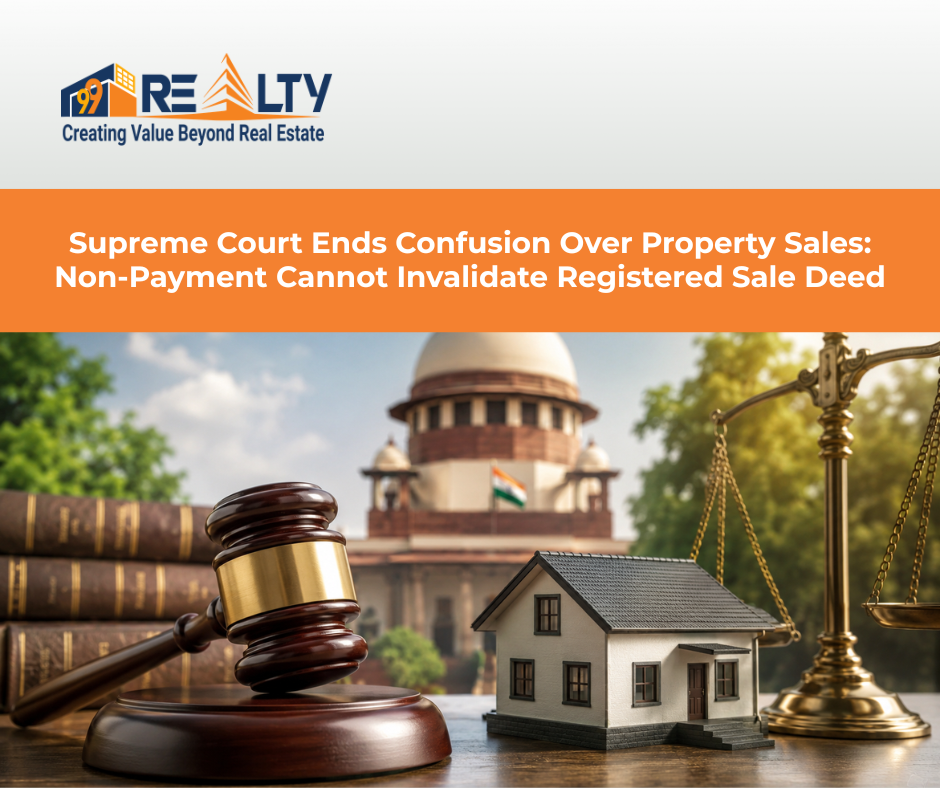
In a significant judgment that is set to influence real estate transactions across India, the Supreme Court has ruled that a registered sale deed cannot be declared invalid merely because the buyer failed to pay the entire sale consideration at the time of execution. The landmark decision reinforces a core principle of Indian property law: once a sale deed is duly registered and ownership is intended to be transferred, the title passes to the buyer irrespective of whether the full payment has been made.
The ruling, delivered by a bench comprising Justice J.B. Pardiwala and Justice K. Vinod Chandran, provides much-needed clarity on the relationship between ownership transfer and payment obligations. For property buyers, sellers, investors, and legal professionals, this judgment carries far-reaching implications.
Supreme Court’s Landmark Ruling Explained
What the Court Held
The Supreme Court unequivocally held that a registered sale deed remains legally valid even when only part of the agreed consideration has been paid. Once the deed is executed and registered with the intention of transferring ownership, the title passes to the buyer.
The court clarified that the seller cannot later seek cancellation of the sale deed solely on the ground that the remaining payment was not made.
Flooded Parking Basements Are India’s New Housing Nightmare
Why the Judgment Matters
Imagine handing over the keys to a house after signing all legal documents and registering the transaction. Can you later claim the house still belongs to you because the buyer did not complete the payment? According to the Supreme Court, the answer is no.
The judgment protects the sanctity of registered documents and prevents property ownership from being thrown into uncertainty due to payment disputes.
Understanding the Legal Principle Behind the Decision
Transfer of Property Act and Ownership Rights
The decision is rooted in the Transfer of Property Act, which governs the transfer of immovable property in India. The law recognizes that ownership is transferred through a valid and registered conveyance when parties intend to pass title.
The emphasis is on the legal act of transfer rather than the complete fulfillment of payment obligations.
Registration vs. Payment Completion
A common misconception in property transactions is that ownership remains with the seller until every rupee has been paid. However, the Supreme Court clarified that registration and transfer of title are separate from payment disputes.
While unpaid consideration may create a financial claim, it does not reverse the transfer of ownership already completed through registration.
Key Observations Made by the Supreme Court
Intent to Transfer Ownership is Crucial
Justice K. Vinod Chandran emphasized that the parties executed the sale deed with full knowledge that only a portion of the consideration had been paid at the time of registration.
This demonstrated a clear intention to transfer ownership despite pending payments.
Non-Payment Does Not Nullify Registration
The court observed:
“The sale deed executed with full knowledge of the part consideration alone having been passed, cannot be rendered void or inoperative merely because the balance consideration promised to be paid had not been complied with.”
This observation establishes a strong precedent for future property disputes involving unpaid balances.
Background of the Maharashtra Property Dispute
Details of the Original Transaction
The case originated from a property dispute in Maharashtra involving two sale deeds.
The seller agreed to transfer two properties for a consideration of ₹7,000 each. At the time of execution, the buyer paid ₹2,500 upfront for each property.
The remaining ₹4,500 per property was to be utilized for clearing liabilities owed by the sellers to various government authorities and financial institutions.
The Dispute Over Balance Consideration
A dispute later emerged regarding the unpaid balance amount. The sellers argued that since the remaining consideration had not been fully paid, the sale deeds should be declared void and ownership restored to them.
This claim triggered a prolonged legal battle that eventually reached the Supreme Court.
Journey Through the Courts
Trial Court Decision
The Trial Court rejected the sellers’ plea. It held that the registered sale deeds remained valid despite partial payment of the sale consideration.
The court found no legal basis for cancelling the deeds.
First Appellate Court Findings
The First Appellate Court agreed with the Trial Court and upheld the validity of the sale deeds.
It maintained that payment disputes could not invalidate a legally registered conveyance.
Bombay High Court Reversal
The Nagpur Bench of the Bombay High Court later overturned the concurrent findings of the lower courts.
The High Court declared the sale deeds inoperative, effectively siding with the sellers.
Supreme Court Restores Lower Court Orders
Upon appeal, the Supreme Court reversed the High Court’s decision.
The apex court concluded that the High Court had improperly interfered with established findings of fact already determined by the lower courts.
As a result, the original decisions validating the sale deeds were restored.
Impact on Real Estate Transactions in India
Implications for Property Sellers
This ruling serves as an important lesson for sellers.
Once a registered sale deed is executed, ownership transfer becomes legally effective. Sellers cannot rely on future payment defaults as a basis for reclaiming ownership.
Therefore, sellers should ensure proper payment safeguards before registration, including:
- Escrow arrangements
- Bank guarantees
- Post-dated cheques
- Legally enforceable payment schedules
Implications for Property Buyers
For buyers, the judgment offers greater certainty regarding ownership rights.
A validly registered sale deed provides strong legal protection against attempts to cancel transactions merely because payment disputes arise later.
However, buyers should not interpret the ruling as a license to withhold payments. Outstanding dues remain legally recoverable.
Impact on Future Litigation
The decision is expected to reduce unnecessary litigation seeking cancellation of sale deeds due to payment defaults.
Courts are likely to focus on monetary recovery rather than ownership reversal in similar cases moving forward.
Legal Remedy Available to Sellers
Civil Suit for Recovery of Money
The Supreme Court made it clear that the proper remedy for an aggrieved seller is to file a civil suit for recovery of the unpaid balance.
This aligns with established principles of contract and property law.
Recovery of Interest on Outstanding Amount
The court further recognized that sellers may seek interest on unpaid consideration.
This ensures that sellers are not left without a remedy while preserving the legal sanctity of registered property transfers.
What This Means for the Indian Real Estate Sector
Strengthening Property Rights
Property ownership forms the foundation of real estate markets. By protecting registered sale deeds from cancellation due to payment disputes, the Supreme Court has strengthened confidence in property rights.
Clear ownership rights encourage investment, lending, and market stability.
Increasing Certainty in Property Transactions
Real estate transactions often involve staggered payments, loan disbursements, and settlement arrangements.
The ruling provides certainty that ownership transfers will not be easily disturbed once registration is complete, creating a more predictable legal environment for buyers and sellers alike.
Property Law Alert : SC Redefines Ownership Rules
Expert View: A Significant Precedent
Legal experts view this judgment as one of the most important property law rulings in recent years.
The decision reaffirms that registration remains the cornerstone of ownership transfer under Indian law. It also discourages parties from using cancellation proceedings as a substitute for legitimate money recovery actions.
For developers, investors, homebuyers, and property owners, the judgment offers valuable clarity on the distinction between title disputes and payment disputes.
Key Takeaways for Property Buyers and Sellers
- A registered sale deed remains valid even if the full consideration has not been paid.
- Ownership transfers upon registration when the parties intend to convey title.
- Sellers cannot seek cancellation of the sale deed merely because the buyer defaults on payment.
- The correct legal remedy is a civil suit for recovery of the outstanding amount and interest.
- The judgment strengthens legal certainty in Indian real estate transactions.
- Buyers gain stronger protection of ownership rights after registration.
- Sellers must adopt stronger financial safeguards before executing sale deeds.
Conclusion
The Supreme Court’s ruling in Raziya Begum & Ors. v. Nafisa Begum Abdul Hamid & Ors. marks a defining moment for Indian property law. By holding that non-payment of the full sale consideration cannot invalidate a registered sale deed, the court has reinforced the legal sanctity of registered transactions and strengthened property ownership rights.
For the Indian real estate sector, the message is clear: registration transfers title, while payment disputes must be resolved through financial recovery mechanisms—not by undoing completed ownership transfers. As property transactions continue to grow in complexity, this judgment provides a stable legal foundation that will guide buyers, sellers, developers, and courts for years to come.
FAQs
1. Can a seller cancel a registered sale deed if the buyer fails to pay the full amount?
No. According to the Supreme Court, non-payment of the full consideration does not invalidate a registered sale deed.
2. When does ownership legally transfer in a property transaction?
Ownership transfers when a valid sale deed is executed and registered with the intention of conveying title.
3. What remedy does a seller have if payment remains unpaid?
The seller can file a civil suit to recover the outstanding balance and claim interest where applicable.
4. Does this ruling apply to all property transactions in India?
The judgment reinforces established principles under the Transfer of Property Act and is likely to guide courts in similar property disputes across India.
5. How does this judgment affect homebuyers and investors?
It provides greater legal certainty by ensuring that registered ownership rights cannot be easily challenged solely because of payment disputes after registration.
Need Help?
Need help evaluating a property or planning your next move in the market?
Reach out to 99 REALTY – your trusted real estate partner for smarter choices.
Subscribe to get updates on our latest posts and market trends.



Join The Discussion