

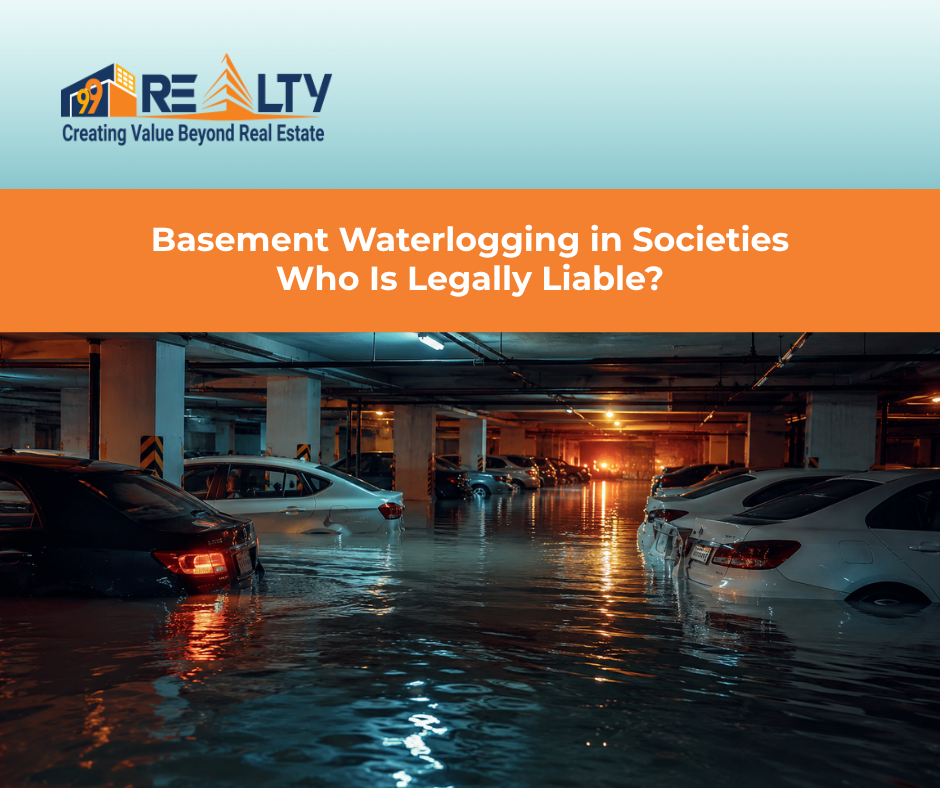
Every monsoon, thousands of Indian apartment residents wake up to the same gut-wrenching sight — their vehicles submerged in what was once described to them as a “safe, covered” basement parking area. But when the water rises, so does an even messier question: who is legally responsible? The builder? The RWA? Or you?
When One Spell of Rain Is Enough
It did not take a cyclone. It did not take two days of non-stop downpour. In one of Bengaluru’s gated residential communities, a single brief pre-monsoon shower was enough to send nearly a foot of water flooding into the basement parking — leaving parked vehicles perilously close to serious damage.
“After recent rain, a huge amount of water has entered the parking lot. It went up to a foot high. Surprised that a single rainfall can lead to this much waterlogging. If the level rises further, vehicles are definitely at risk. In a situation like this, who is actually liable for the damage? Builder, association, or is it on the owners?” — Bengaluru resident, Reddit
It is a question that cuts to the heart of how residential infrastructure is designed, maintained, and ultimately held accountable in India’s rapidly urbanizing cities. And the answer, as legal experts make clear, is far more layered than most residents expect.
India’s Basement Flooding Crisis Is Becoming the New Normal
Across India’s major cities — from Noida’s Supertech Eco Village, where residents found cars fully submerged in flooded basement parking after heavy rains, to Gurugram’s Sector 57, where a resident went viral posting videos of his BMW, Mercedes, and i20 half-drowned after a single evening’s rainfall in July 2024 — the story repeats with depressing predictability every year.
The root cause is rarely a surprise. Rapid vertical construction, shrinking green cover, outdated drainage networks, and basement parking designs that underestimate stormwater load are the standard recipe for disaster. The National Disaster Management Authority (NDMA) estimates that over 40 million urban residents are directly vulnerable to flooding every monsoon. Yet most apartment buyers in India sign their agreements without ever asking what happens to their car when the basement fills with water.
CCTV in Apartments: What Every Homeowner Must Know
The Legal Landscape: Three Lines of Accountability
1. The Developer’s Responsibility — And the Five-Year Window
When basement flooding stems from faulty drainage design or poor construction quality, the developer is squarely in the frame — but only within a defined legal window.
Under the RERA Act, 2016, the defect liability period gives homebuyers a five-year window from the date of possession to seek remedies for structural defects at no cost to them. This includes inadequate drainage or waterproofing failures that result in basement flooding.
“If the issue arises within the defect liability period, homebuyers can approach the RERA court, which may direct the developer to rectify defects such as inadequate drainage or faulty design. However, RERA typically focuses on corrective action and may not award compensation for consequential losses like vehicle damage.” — Advocate Akash Bantia
“Till the occupancy certificate is obtained, the responsibility of maintaining the project rests with the developer, and several judicial precedents have held that maintenance during this period must be undertaken at the builder’s cost.” — Advocate Chandrachud Bhattacharyya
For establishing developer liability, technical evidence is non-negotiable. Reports from engineers or architects confirming structural or design deficiencies are essential. Once the five-year defect liability period lapses, the RERA route narrows significantly. In such cases, consumer courts may offer a stronger path for claiming damages where negligence or structural defects in drainage can be established.
2. The RWA’s Role — Maintenance, Not Design
A common misconception is that the Resident Welfare Association (RWA) is responsible for how the drainage system was originally designed. Legal experts are clear: the RWA’s accountability begins after handover, and is limited to maintenance — not original infrastructure planning.
If drainage channels are blocked due to poor upkeep, sump pumps are non-functional entering monsoon season, or the association failed to issue timely flood warnings about a known risk — the RWA can be held liable for negligence. Under the landmark Supreme Court ruling in Nahalchand Laloochand Pvt. Ltd. vs. Panchali Cooperative Housing Society Ltd. (AIR 2010 SC 3607), basement and stilt parking areas are classified as common areas, placing their upkeep firmly within the Managing Committee’s sphere of responsibility.
3. Insurance — The Fastest, Most Reliable Relief
Here is where legal experts, the Reddit community, and practical experience all converge on one clear answer: insurance is your first and best line of defence.
“Motor insurance policies are designed to cover such risks, and vehicle owners should ideally claim damages through their insurer. Legal recourse against developers or other parties may take time and is often uncertain, whereas insurance provides immediate relief.” — Advocate Akash Bantia
The critical point: a basic third-party insurance policy covers absolutely nothing when your own car floods. For flood protection, you need a comprehensive motor insurance policy, which covers engine damage from water ingestion, electrical failures, interior damage, and even total loss. Attempting to start a waterlogged car — the most instinctive but catastrophic mistake — can cause hydrostatic engine lock, an act that most insurers use to void the claim entirely.
The Force Majeure Trap — Can Builders Walk Away?
One legal argument developers often invoke when flooding occurs is force majeure — the “act of God” clause. Under RERA, this covers genuinely unforeseeable disruptions such as cyclones, earthquakes, or events like the COVID-19 pandemic. But the law draws a firm line.
“Routine or even heavy monsoon rainfall does not fall within this category, as it is a predictable, seasonal occurrence. Developers cannot typically invoke force majeure for issues like basement flooding or waterlogging arising during the monsoon, particularly if these stem from inadequate drainage design or poor construction.” — Advocate Chandrachud Bhattacharyya
In other words: if your basement floods every July, your developer cannot hide behind an “act of God” defence. Monsoons are not surprises in India — they are certainties. Buildings are supposed to be designed accordingly.
The Truth About Force Majeure and Possession Delays
What To Do If Your Car Is Damaged in a Flooded Basement
- Do not start the engine. Water in the engine bay can cause catastrophic hydrostatic lock if the engine is cranked. This single action transforms a recoverable claim into a voided policy.
- Document everything immediately. Photograph and video the flooded premises, waterline inside/outside your vehicle, visible drainage failures, and your car’s condition — before water levels recede.
- Notify your insurer within 24–48 hours. Delayed intimation is one of the most common grounds for partial or total rejection of flood damage claims.
- File a written complaint with the RWA. Put the date, time, and nature of the event in writing and request a formal response. This paper trail is essential for any future legal action.
- Assess your legal options. Within the 5-year RERA period, approach the RERA authority with technical documentation. After the period lapses, a consumer forum complaint may be the stronger route.
The Pre-Purchase Checklist No One Gives You
If you are buying a flat with basement parking — whether in Noida, Ranchi, Lucknow, Jamshedpur, or Dhanbad — these questions are non-negotiable:
- Has the basement waterproofing been independently certified by a structural engineer?
- Is there a functional sump pump system and what is its water evacuation capacity?
- Is the project located in a low-lying or flood-prone zone?
- What is the society’s documented pre-monsoon maintenance protocol?
- Has the builder provided flood management documentation in the sale agreement?
What the builder or RWA says — and how quickly they say it — will tell you far more about your future home’s safety than any site visit or brochure ever will.
The Bottom Line
The Bengaluru basement flooding episode is not a freak event. It is a preview of what monsoon season looks like across India’s fastest-growing apartment markets. When the water rises, three parties share the accountability: a developer who must build infrastructure that withstands predictable weather; an RWA that must maintain it diligently; and a resident who must be insured comprehensively enough to seek immediate relief while longer legal remedies play out.
Need Help?
Need help evaluating a property or planning your next move in the market?
Reach out to 99 REALTY – your trusted real estate partner for smarter choices.
Subscribe to get updates on our latest posts and market trends.




Join The Discussion