


Building a home is one of the most personal investments a person will ever make. It is also one of the most financially vulnerable moments in the property lifecycle. Across markets—whether in India, Southeast Asia, the Middle East, or Europe—the story is strikingly similar: budgets stretch, timelines slip, and costs quietly inflate long before the keys are handed over.
After more than two decades in real estate advisory and on-ground project experience, one lesson stands firm: saving money while building a home is not about cutting corners. It is about cutting inefficiencies.
True cost control comes from informed decisions, disciplined planning, and understanding where money actually adds value—and where it simply leaks.
The Real Cost of Poor Planning
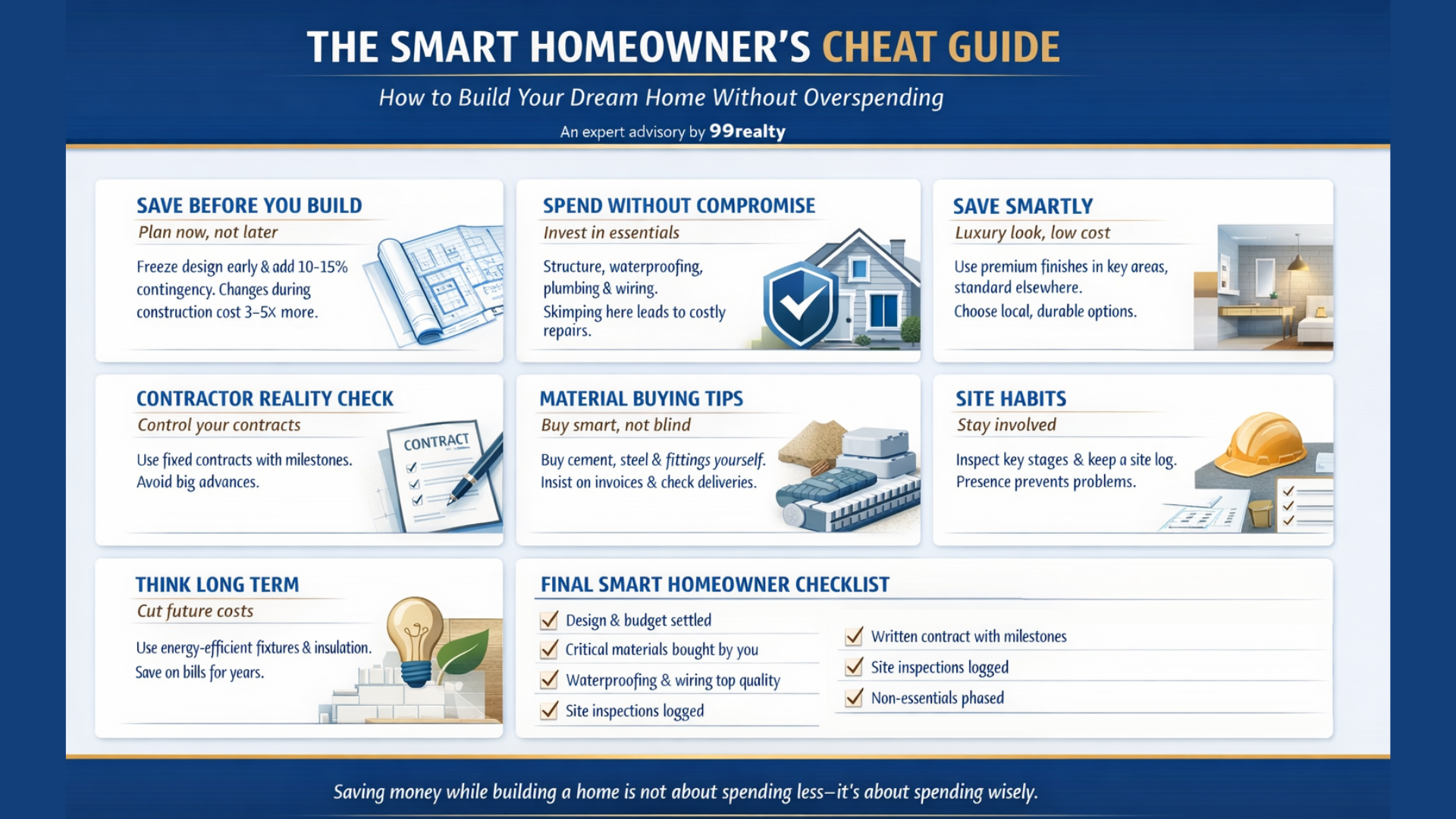
Most budget overruns occur long before construction begins. A poorly resolved design, vague scope definitions, or an incomplete cost estimate inevitably lead to revisions mid-construction. And revisions, in real estate, are expensive.
Internationally successful residential projects share one principle: design certainty. Floor plans are finalised early, material selections are locked, and quantities are defined in advance. When homeowners know exactly what is being built, contractors have little room to improvise costs.
A compact, efficiently planned home often costs less per square foot than a larger but poorly organised one. Thoughtful design—fewer structural offsets, efficient plumbing lines, and balanced proportions—can reduce material consumption and labour hours without affecting aesthetics or comfort.
In real estate, clarity is currency.
Homebuying Anxiety: The Hidden Stress No One Talks About
Contractors, Contracts, and the Price of Ambiguity
The relationship between homeowner and contractor is where budgets are either protected or quietly drained.
The most common mistake homeowners make is entering loosely defined agreements—verbal assurances, flexible pricing, or “we’ll adjust later” clauses. In practice, these translate into escalations, substitutions, and disagreements.
Globally, professional residential projects operate on defined scopes and milestone-based payments. Materials, brands, finishes, and specifications are written—not implied. Payments are released only after verifiable progress. A small retention amount is held until final handover, ensuring accountability.
Contrary to popular belief, a competent contractor does not cost more. Poor execution does. Delays, rework, material wastage, and labour mismanagement often exceed the difference between an average and a skilled professional.
Trust is important. Documentation is essential.
Unlocking the Secrets of Residential vs Commercial Property
Where Smart Homeowners Spend—and Where They Save
Not all components of a home carry equal weight. Some deserve investment; others simply demand practicality.
Structural integrity, waterproofing, plumbing, and electrical systems are long-term assets. These elements are expensive to repair once concealed, and failures often surface years later—at far greater cost. Using proven materials, qualified workmanship, and proper testing here is not a luxury; it is financial foresight.
Conversely, finishes are where homeowners can exercise restraint. International residential trends increasingly favour durability and simplicity over excess. High-quality vitrified tiles, engineered stone, or locally sourced materials often provide the same visual appeal as imported finishes, at a fraction of the cost.
Customisation is another hidden expense. Standardised door sizes, window modules, and fittings reduce fabrication costs and speed up construction. Bespoke elements should be limited to focal areas, where they add real experiential value rather than inflate the entire budget.
Achieving Style Without Overspending
Style in budget, comes from restraint and clarity, not excess.
Minimalist design principles—clean lines, neutral palettes, and functional furniture—are globally recognized for delivering elegance without unnecessary cost. Instead of spending heavily indoors, many homeowners extend their living space outward with modest porches or patios built using cost-effective materials. These spaces add lifestyle value disproportionate to their cost.
Creative reuse also has its place. Repurposed furniture, modular storage, and simple vertical gardens add character while keeping spending in check. When applied thoughtfully, these elements enhance personality without undermining durability.
The Silent Cost of Material Substitution
Material substitution remains one of the most common budget and quality risks in residential construction worldwide. What is specified is not always what arrives on site.
Smart homeowners take ownership of critical material procurement—cement, steel, sanitaryware, wiring, and waterproofing systems—sourcing them directly from authorised dealers/ wholesalers and maintaining proper invoices. This simple step dramatically reduces the risk of grade dilution and short-weight deliveries.
Documentation matters. Delivery challans, batch numbers, and photographic records create transparency. They also signal seriousness. Contractors are far less likely to cut corners when oversight is consistent and informed.
The goal is not confrontation; it is control.
Saving Beyond Construction: The Lifecycle View
International real estate markets increasingly evaluate homes not just on construction cost, but on lifetime operating expense.
Energy-efficient lighting, well-insulated envelopes, water-saving fixtures, and climate-responsive design reduce monthly outflows for decades. While some of these choices marginally increase initial costs, they pay for themselves through reduced utility bills and improved comfort.
A home that costs slightly more to build but significantly less to run is, in real terms, the more economical investment.
The Discipline of Phased Spending
One of the most effective cost-control strategies used globally is phased execution.
Not every element of a home needs to be completed on day one. Structural work, waterproofing, services, and basic finishes form the essential core. Decorative elements, landscaping, advanced automation, or high-end furnishings can follow later—when finances are more flexible and choices more informed.
Phasing preserves liquidity and reduces the pressure to make rushed decisions under construction timelines.
In real estate, timing is as valuable as pricing.
Avoiding the False Economy Trap
Skipping approvals, ignoring technical supervision, or compromising on hidden systems may reduce upfront expense—but the financial repercussions surface quickly. Structural corrections, regulatory penalties, and chronic maintenance issues have a way of appearing when they are most disruptive and most expensive to address.
What often begins as a “temporary adjustment” or a “minor saving” can escalate into long-term liability. Poor waterproofing leads to persistent seepage and mold. Substandard electrical work increases fire risk. Inferior plumbing demands repeated repairs that require breaking finished walls and floors. These costs rarely appear in the initial budget—but they accumulate steadily over the life of the home.
There is also an invisible cost that homeowners underestimate: asset value. Homes built without proper approvals, compliance, or documentation face difficulties during resale, refinancing, or redevelopment. Buyers discount risk aggressively, and lenders are unforgiving of irregularities. What was saved during construction is often lost many times over at exit.
Seasoned homeowners understand that true economy lies in durability, compliance, and foresight. Spending wisely on systems that are concealed—but critical—protects not only daily comfort but also long-term market value.
In real estate, the cheapest decision is rarely the most economical one. Money saved today at the cost of durability, safety, or legality is not a saving at all—it is deferred expense, waiting to return with interest.
A Smarter Definition of Value
Building a dream home is not about spending less. It is about spending wisely.
Homes that hold value over time are those built with discipline—clear planning, transparent execution, and long-term thinking. They age gracefully, cost less to maintain, and retain market appeal.
At 99realty, we advocate an ownership mindset rooted in knowledge rather than fear. When homeowners understand where money works hardest, they stop overspending—and start building confidently.
Need Help?
Need help evaluating a property or planning your next move in the market?
Reach out to 99 REALTY – your trusted real estate partner for smarter choices.
Subscribe to get updates on our latest posts and market trends.


Join The Discussion