

Think about any building in India — from a cozy rural home to a towering city apartment — and you’ll find one thing in common: bricks. They’re not just tiny blocks of baked clay; they’re the unsung heroes of every structure. Bricks decide how strong, stable, and long-lasting your building will be. But here’s the tricky part — not all bricks are created equal.
In India, with its diverse climates and soils, the type of brick you choose can make or break your construction quality. So let’s explore the types, classifications, advantages, and the impact of brick selection in Indian real estate.
Explore the Benefits of Green Building Certifications in Real Estate
Classification of Bricks in India
India’s brick industry is massive and diverse. The classification depends mainly on how they’re made, their quality, and the materials used.
1. Based on Manufacturing Method
a. Hand-Made Bricks
The traditional choice — made manually using molds and sun-dried before firing. While affordable, they tend to have irregular shapes and variable strength.
b. Machine-Made Bricks
Produced using automated systems ensuring uniform shape, strength, and finish. Ideal for modern construction demanding precision.
2. Based on Quality (First to Fourth Class)
a. First-Class Bricks
These are premium-quality, well-burnt, and uniform in color. Perfect for load-bearing walls and exposed masonry.
b. Second-Class Bricks
Slightly less uniform but still durable. Commonly used for internal walls and hidden brickwork.
c. Third-Class Bricks
Under-burnt and softer, suitable only for temporary or rural constructions.
d. Fourth-Class Bricks
Over-burnt and brittle. Often crushed and reused as aggregates for roads or foundations.
3. Based on Raw Material Used
a. Clay Bricks
The oldest and most popular type. Made from clay and baked at high temperatures — they’re strong but not very eco-friendly.
b. Fly Ash Bricks
Made from fly ash (a waste from thermal power plants), sand, and cement. Lightweight, strong, and sustainable.
c. Concrete Bricks
Formed from cement, sand, and aggregates. Known for high compressive strength and modern appearance.
d. AAC (Autoclaved Aerated Concrete) Blocks
A new-age brick made from fly ash, lime, and cement. They’re light, thermally efficient, and eco-conscious.
e. Fire Bricks
Specially designed to withstand extreme heat — perfect for chimneys, furnaces, and kilns.
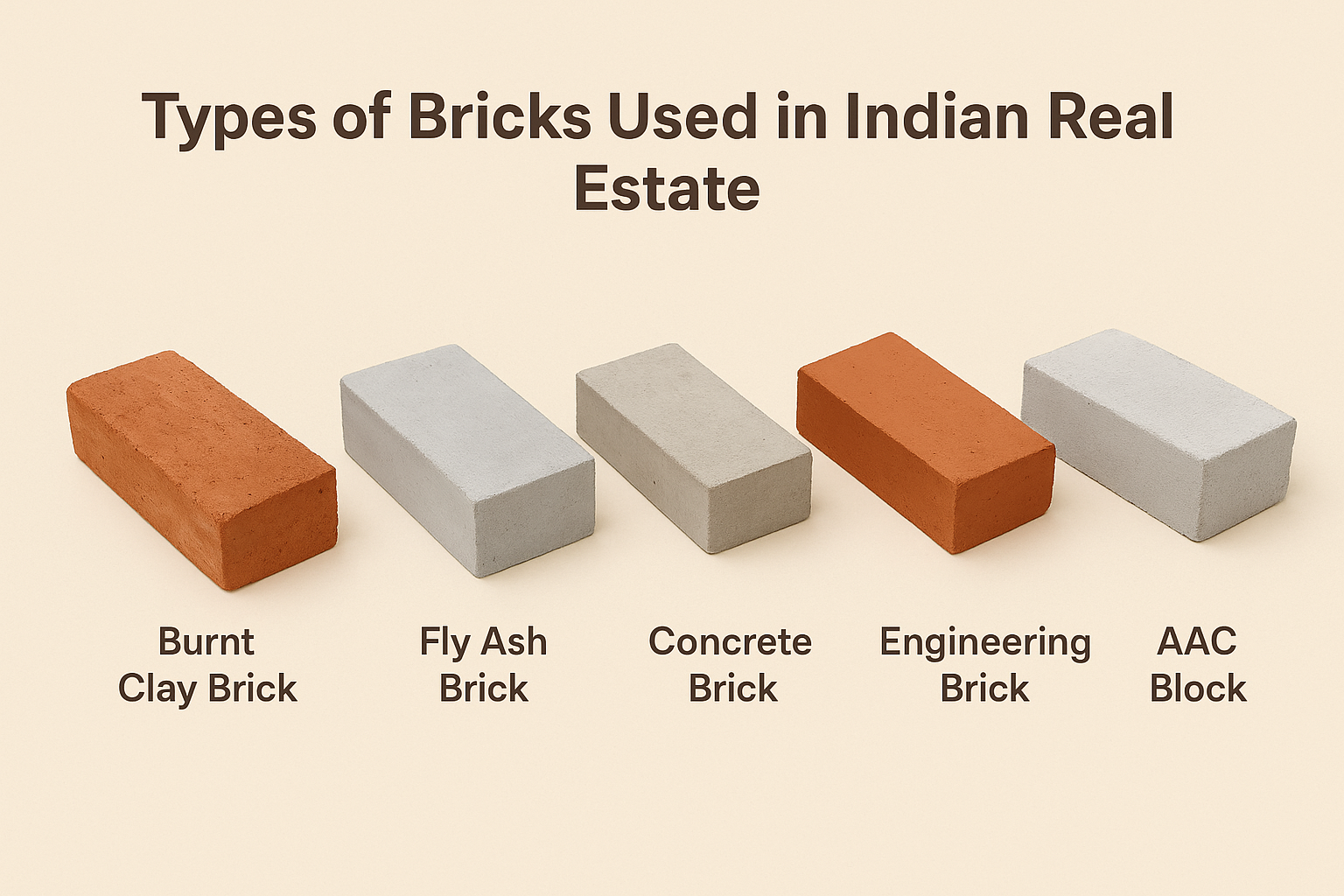
Common Types of Bricks Used in Modern Indian Construction
1. Burnt Clay Bricks
These are the most traditional type, widely used for decades. They’re reliable, strong, and available everywhere — though they can be heavy and less uniform.
2. Fly Ash Bricks
Modern builders love these for being eco-friendly and having a smooth finish. They also minimize plaster usage and resist water seepage.
Rainwater Harvesting: A Timely Reckoning for Real Estate
3. Concrete Bricks
Ideal for load-bearing structures and architectural walls. They offer excellent durability and noise insulation.
4. Engineering Bricks
Highly dense and water-resistant, used where strength and moisture resistance matter most — like basements and foundations.
5. AAC Blocks
Lightweight and thermally efficient. Builders choose AAC for high-rise construction due to its easy handling and energy-saving properties.
Comparative Analysis: Traditional vs Modern Bricks
Durability and Strength
Clay and engineering bricks offer unmatched durability, while AAC and concrete bricks provide adequate strength for modern projects.
Thermal Insulation and Energy Efficiency
AAC and fly ash bricks win here — they keep interiors cool in summer and warm in winter, saving on energy costs.
Cost-Effectiveness
Traditional burnt clay bricks are cheaper initially, but modern options like AAC and fly ash bricks cut long-term costs through efficiency and lower maintenance.
Eco-Friendliness
Fly ash and AAC blocks are clear winners — made from industrial waste and requiring less energy to produce.
Regional Preferences of Bricks in India
Northern India
Clay and fly ash bricks dominate due to easy raw material availability and weather adaptability.
Southern India
AAC and concrete bricks are more popular here, especially in urban areas focusing on sustainable construction.
Eastern and Western India
Regions like Bengal and Gujarat are shifting towards fly ash and cement-based bricks to reduce pollution from traditional kilns.
How Brick Choice Affects Construction Quality
Structural Strength
Strong bricks = strong buildings. Poor-quality bricks compromise load-bearing capacity and can cause cracks or uneven settlement.
Moisture Resistance
Fly ash and AAC bricks reduce water absorption, preventing dampness and plaster damage.
Longevity and Maintenance
Good-quality bricks ensure buildings stand tall for decades without needing frequent repairs.
Aesthetic Appeal
Uniform, smooth bricks lead to neater finishes, saving plaster and paint costs.
Advantages of Different Types of Bricks
Burnt Clay Bricks
- High compressive strength
- Traditional look
- Readily available
Fly Ash Bricks
- Lightweight and smooth surface
- Eco-friendly and energy-efficient
- Lower water absorption
Concrete Bricks
- High durability
- Noise insulation
- Consistent dimensions
AAC Blocks
- Lightweight and thermally efficient
- Quick installation
- Best for earthquake-prone zones
Which Brick Type is Best for Your Project?
For Residential Homes
Fly ash and AAC blocks are ideal. They’re lightweight, soundproof, and provide better insulation for comfort.
For Commercial Buildings
Concrete and engineering bricks are more suitable due to strength and load-bearing capacity.
For Eco-Friendly Projects
AAC and fly ash bricks take the crown — they reduce carbon footprint and reuse industrial waste.
Tips for Choosing the Right Brick
Consider the Soil and Climate
For humid or coastal areas, go for low water-absorption bricks like fly ash or AAC.
Check Strength and Absorption Rates
Always look for IS-certified bricks with compressive strength above 3.5 N/mm² for general construction.
Don’t Ignore Local Availability
Locally produced bricks often cost less and are tailored to local environmental conditions.
Conclusion: Building a Strong Future, One Brick at a Time
Bricks aren’t just building blocks — they’re the foundation of India’s dreams, from rural huts to skyscrapers. The right brick type doesn’t just define the structure’s strength; it defines its future.
Choosing the right brick is about balancing cost, strength, sustainability, and design. As India moves towards eco-conscious urbanization, the shift to modern, greener alternatives like fly ash bricks and AAC blocks marks a step toward a more sustainable and smarter real estate landscape.
FAQs
1. Which type of brick is the strongest for construction?
Engineering bricks are considered the strongest due to their density and resistance to water and weather.
2. Are fly ash bricks safe for home construction?
Absolutely. They are non-toxic, durable, and environmentally friendly, making them perfect for homes.
3. Why are AAC blocks becoming popular in India?
They’re lightweight, easy to handle, provide excellent thermal insulation, and are sustainable — ideal for modern projects.
4. Can I mix different types of bricks in one project?
Yes, but only if they have similar compressive strength and expansion properties. Always consult a structural engineer first.
5. Which brick type offers the best thermal insulation?
AAC blocks provide the best thermal insulation, keeping homes cooler in summer and warmer in winter.
Need Help?
Need help evaluating a property or planning your next move in the market?
Reach out to 99 REALTY – your trusted real estate partner for smarter choices.
Subscribe to get updates on our latest posts and market trends.



Join The Discussion