

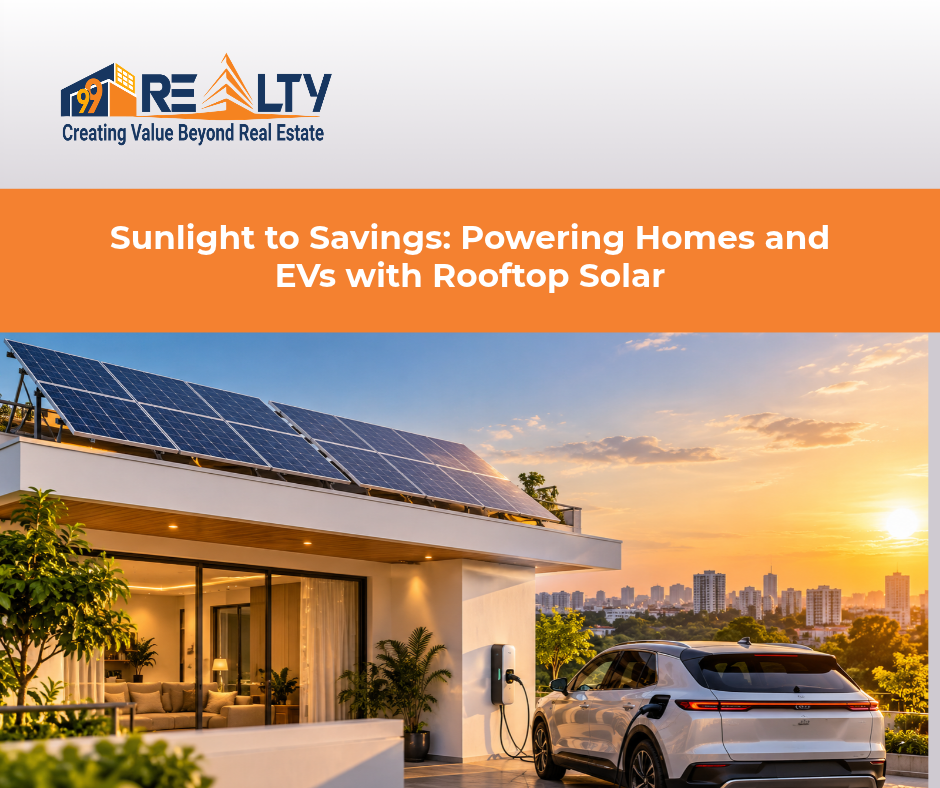
For decades, the rooftop was one of the most underused spaces in an Indian home. It was mostly reserved for drying clothes, children’s playtime, keeping plants, or even giving the family pet a little extra space to roam. Today, however, that familiar rooftop is taking on a far more valuable role—it can become a source of clean energy for your home and even your electric vehicle.
Today, that is changing.
As electricity bills rising, fuel costs remain unpredictable and electric vehicles become increasingly common, the humble rooftop is beginning to look less like empty space and more like a personal energy asset.
Install solar panels on the roof, generate electricity during the day, use that power inside the house—and, with the right setup, use the same electricity to charge an electric vehicle.
One roof. Two major expenses. One source of energy.
From electricity consumer to electricity producer
The basic idea behind rooftop solar is simple.
Solar panels convert sunlight into electricity. A grid-connected rooftop system can supply power to the household, while surplus electricity can be exported to the grid depending on the applicable state regulations and net-metering arrangement.
That can significantly reduce the amount of electricity a household needs to purchase from the grid.
India’s rooftop solar movement is already accelerating. Under the PM Surya Ghar: Muft Bijli Yojana, more than 51.58 lakh households had benefited from rooftop solar installations by August 12, 2026, with nearly 19 lakh households reporting zero electricity bills in the scheme’s progress data.
The momentum is visible beyond the numbers. India had 32.59 GW of grid-connected rooftop solar capacity as of August 31, 2026, according to the Ministry of New and Renewable Energy.
In other words, rooftop solar is moving from an alternative-energy idea into a mainstream residential consideration.
The subsidy equation
For homeowners considering installation, the government’s PM Surya Ghar scheme can make the initial investment more manageable.
Under the central subsidy structure, residential consumers can receive ₹30,000 per kW for the first 2 kW, ₹18,000 per kW for the additional 1 kW, with the total central subsidy capped at ₹78,000 for systems above 3 kW.
In July 2026, the Ministry of New and Renewable Energy also highlighted concessional financing provisions, including collateral-free loans through nationalised banks at a concessional rate linked to the repo rate.
The actual cost, savings and payback period, however, depend on factors such as system size, electricity consumption, rooftop conditions, local tariffs, generation, financing and the applicable state/DISCOM rules.
India’s Next Real Estate Growth Story
Now add an EV to the equation
This is where the story gets more interesting.
Imagine a household with rooftop solar and an electric car parked downstairs.
During the day, the panels generate electricity. The home consumes what it needs. Depending on the system and energy-management setup, electricity can also be directed towards EV charging.
Instead of buying petrol or diesel every few weeks, the household can use electricity generated on its own rooftop to put energy back into the car.
It doesn’t mean the EV is literally running directly from a single solar panel—the solar electricity first flows through the home’s electrical system and charging equipment. But economically, the connection is powerful: the same rooftop investment can support both household electricity consumption and vehicle charging.
And the timing can work particularly well when charging is aligned with solar generation.
The Ministry of Power’s 2024 EV-charging guidelines distinguish between solar and non-solar hours, with solar hours defined as 9 AM to 4 PM for the relevant tariff provisions.
What does the saving actually look like?
Consider a simple example.
A family installs a rooftop solar system that generates electricity for its household consumption and also uses a portion of that generation to charge an EV.
If the car travels 1,000 km a month and consumes roughly 15 kWh per 100 km, it would require around 150 kWh of electricity for that distance.
At a hypothetical ₹8 per unit of grid electricity, that represents about ₹1,200 worth of electricity.
If a meaningful portion of that charging demand is supplied by the household’s solar generation, the effective energy cost of driving can fall substantially.
Compare that with an internal-combustion vehicle, where every kilometre ultimately depends on purchased petrol or diesel.
The exact saving will vary widely by vehicle efficiency, electricity tariff, solar generation, charging losses, driving pattern and fuel prices. But the principle remains: generate your own electricity and use it for more than just lights, fans and appliances.
The Indian rooftop is becoming an energy hub
This shift is already influencing how homes and residential communities are being planned.
The government’s rooftop-solar framework also provides for support for common facilities in group housing societies and RWAs, including EV charging infrastructure, subject to the scheme’s conditions.
Meanwhile, states are pushing their own rooftop-solar initiatives. In September 2026, Bihar announced an additional state subsidy initiative for rooftop solar, supplementing the central support available to households.
Delhi also launched a dedicated PM Surya Ghar registration portal in September 2026 to simplify rooftop-solar adoption.
The direction is becoming increasingly clear: the future home may not only consume energy—it may produce, manage and use it intelligently.
What homebuyers should look for
For someone buying or building a home today, solar readiness could become an increasingly relevant feature.
Look beyond the apartment’s interiors.
Ask:
- Is the rooftop suitable for solar installation?
- Is there sufficient roof area and sunlight exposure?
- Are electrical systems designed to accommodate future solar and EV charging?
- Does the society permit individual or common-area solar installations?
- Is EV charging infrastructure available or planned?
- What are the applicable DISCOM and state regulations?
- What financing or subsidy options are currently available?
Because tomorrow’s definition of a “well-planned home” may extend beyond bedrooms, balconies and amenities.
It could include how intelligently the home uses energy.
The bigger picture
The solar panel on a rooftop may look like a small piece of infrastructure.
But connect it to the household electricity bill, an EV charger and India’s growing clean-energy ecosystem—and it becomes something much bigger.
A home that generates its own electricity can potentially reduce its dependence on the grid.
An EV charged using that electricity can reduce dependence on conventional automotive fuel.
And together, they point towards a different idea of homeownership:
Your home doesn’t just cost you money. With the right infrastructure, part of it can help save you money every month.
The rooftop, once simply the top of the house, could become one of its most valuable assets.
Need Help?
Need help evaluating a property or planning your next move in the market?
Reach out to 99 REALTY – your trusted real estate partner for smarter choices.
Subscribe to get updates on our latest posts and market trends.



Join The Discussion