

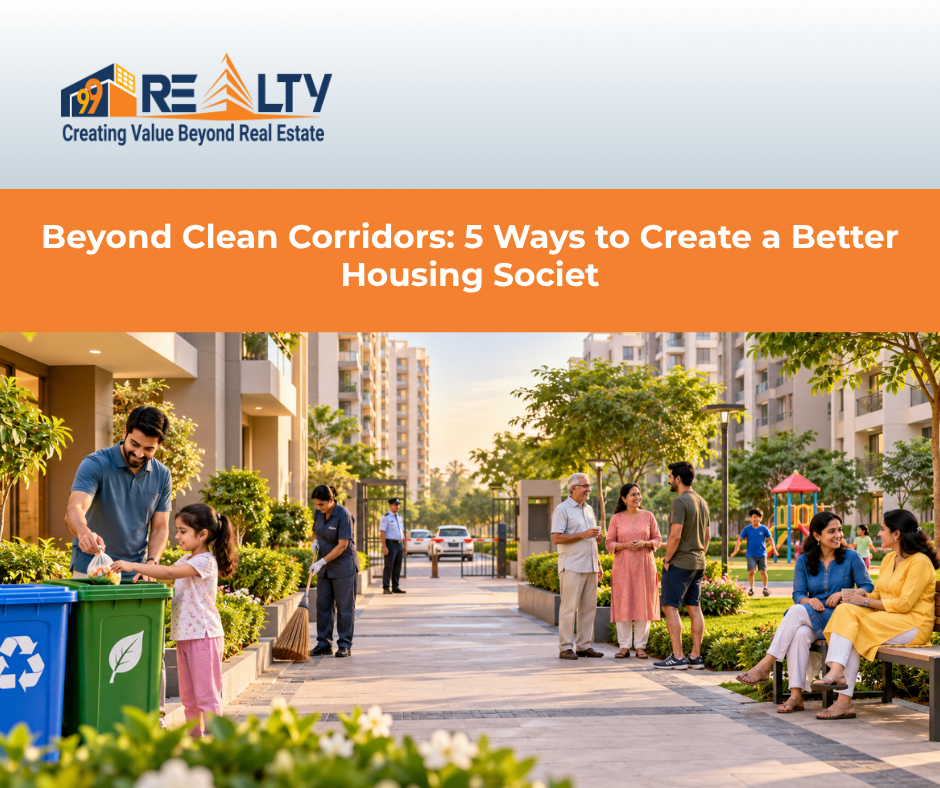
A clean apartment complex is easy to admire. Maintaining one—and keeping hundreds of residents on the same page—is the real challenge. Here are five practical ways Indian housing societies can improve cleanliness, maintenance and community harmony.
Walk through any busy residential society in India and you will see a small version of the country itself.
Families and senior citizens share corridors with young professionals and children. Owners live alongside tenants. Domestic workers, delivery executives, security guards and maintenance teams move through the same gates every day. Festivals bring everyone together, while parking, pets, noise, garbage and maintenance bills can sometimes drive them apart.
This is the reality of community living.
In such an environment, maintaining a society is not simply about sweeping floors or repairing a lift. It is about creating systems that work—and ensuring residents understand and participate in them.
For Resident Welfare Associations (RWAs), Apartment Owners Associations (AOAs) and managing committees, the challenge is particularly significant. A decision that seems minor to one resident can directly affect another.
So, how can Indian housing societies maintain cleaner surroundings while reducing everyday conflicts?
Here are five practical approaches.
99realty.in/cctv-in-apartments-what-every-homeowner-must-know/
Make Waste Management a Daily Habit, Not a Monthly Campaign
Garbage remains one of the most visible indicators of how well a residential society is managed.
Overflowing bins, garbage thrown from balconies, waste left outside flats and poor segregation can quickly create hygiene problems. During summer, the problem can become worse because of odour, insects and stray animals.
The answer is not simply to hire more housekeeping staff.
Societies need to make waste segregation and responsible disposal a resident-level responsibility.
Wet and dry waste should be separated wherever local municipal systems support it. Clearly marked bins should be placed at appropriate locations, and residents should be informed about what belongs where.
Housekeeping staff should also receive proper equipment and instructions rather than being expected to manually sort mixed household waste.
Societies can go a step further by conducting short awareness drives, especially for new residents and children. Instead of issuing warnings for every violation, committees can initially focus on education and consistent implementation.
The objective should be simple: don’t just clean the society—prevent it from becoming dirty in the first place.
Put Parking, Noise and Common-Area Rules in Writing
Few subjects can turn neighbours into opponents faster than a parking dispute.
A visitor’s vehicle occupying a resident’s space, two-wheelers blocking passages, cars parked in fire-access areas or residents using someone else’s designated parking can quickly lead to arguments.
Noise is another familiar issue. Weddings, festivals, late-night gatherings, renovation work and loud music are all part of urban Indian life, but they can also disturb neighbours.
The solution is not to eliminate these activities. It is to establish clear and reasonable rules.
Every society should have easily accessible guidelines covering parking, renovation timings, use of common areas, noise, waste disposal, pets, visitor management and other recurring issues.
The rules should be communicated when residents move in and whenever significant changes are made.
Most importantly, they should apply consistently.
Rules that are enforced strictly against one resident but ignored for another are likely to create more conflict than the original problem.
Fairness matters as much as the rule itself.
Don’t Let WhatsApp Become the Society Courtroom
Indian housing societies have embraced WhatsApp as an everyday communication tool. It is useful for sharing maintenance notices, water-supply updates, security alerts and emergency information.
But it can also become a source of conflict.
A minor complaint posted publicly can quickly attract replies from dozens of residents. Personal accusations, angry messages and forwarded claims can turn a simple maintenance issue into a community-wide argument.
This is why societies need a proper grievance-redressal mechanism.
Residents should have a clear channel for reporting issues—whether through an office, complaint register, official email or society-management application.
The committee should acknowledge complaints, assess them and communicate the outcome where appropriate.
If two residents have a disagreement, the first step should generally be private communication or mediation rather than public naming and shaming.
A useful principle for every society WhatsApp group is:
Use the group to solve problems, not to win arguments.
Make Maintenance Money and Major Decisions Transparent
Maintenance charges are unavoidable in apartment living. Security, housekeeping, lifts, generators, water systems, common-area electricity, repairs and other services all cost money.
Problems arise when residents do not understand where that money is going.
Questions about maintenance increases, painting contracts, lift repairs, security agencies or large repair projects can quickly become contentious if information is limited.
Transparency can prevent much of this.
Managing committees should communicate major expenditures and projects clearly. Where appropriate, residents should be informed about quotations, expected costs, timelines and the reason for the work.
For example, instead of simply announcing that a large repair contribution is required, the committee can explain:
- What needs to be repaired
- Why the repair is necessary
- The estimated cost
- How the contribution has been calculated
- The expected timeline
Digital maintenance statements and online notices can make this process easier.
At the same time, residents also have a responsibility: questions are healthy, but discussions should remain respectful and based on facts.
Transparent management creates trust; trust makes difficult decisions easier.
Build a Community That Knows How to Disagree
The final—and perhaps most important—ingredient is community spirit.
Indian societies are often at their best when residents come together. Diwali celebrations, Durga Puja, Ganesh Chaturthi, Independence Day programmes, Holi gatherings, sports events, plantation drives and children’s activities can create connections that go beyond simply living in the same building.
These interactions matter when disagreements occur.
A resident is more likely to approach a neighbour calmly when they know each other rather than seeing them as a stranger behind another apartment door.
Societies can encourage inclusive activities while also ensuring that celebrations respect residents who may have different schedules, ages and needs.
Senior citizens, children, tenants and families should all have a voice in community life.
The goal is not to create a society where everyone agrees with everyone.
That is unrealistic.
The goal is to create a society where people can disagree without turning every disagreement into a personal conflict.
The Real Meaning of a Well-Maintained Society
A well-maintained housing society is not defined only by polished lobbies, functioning lifts or landscaped gardens.
It is defined by how efficiently everyday problems are handled.
Who takes responsibility when garbage piles up?
How quickly is a water complaint addressed?
What happens when residents disagree over parking?
Are maintenance expenses communicated clearly?
Can a resident raise a concern without being publicly attacked?
These questions reveal the real quality of community management.
For India’s rapidly growing apartment communities, the answer lies in a combination of clear rules, responsible residents, accountable management and respectful communication.
Cleanliness cannot be outsourced entirely to housekeeping staff. Conflict cannot be solved by issuing more notices. And good community living cannot be created by an RWA alone.
It requires participation from everyone.
Five principles for a better society:
Keep it clean.
Keep the rules clear.
Keep communication respectful.
Keep finances transparent.
Keep the community connected.
Because ultimately, a residential property is more than its walls, amenities and square footage.
A good home is where you live. A good society is where you can live peacefully.
— 99Realty
Need Help?
Need help evaluating a property or planning your next move in the market?
Reach out to 99 REALTY – your trusted real estate partner for smarter choices.
Subscribe to get updates on our latest posts and market trends.



Join The Discussion