

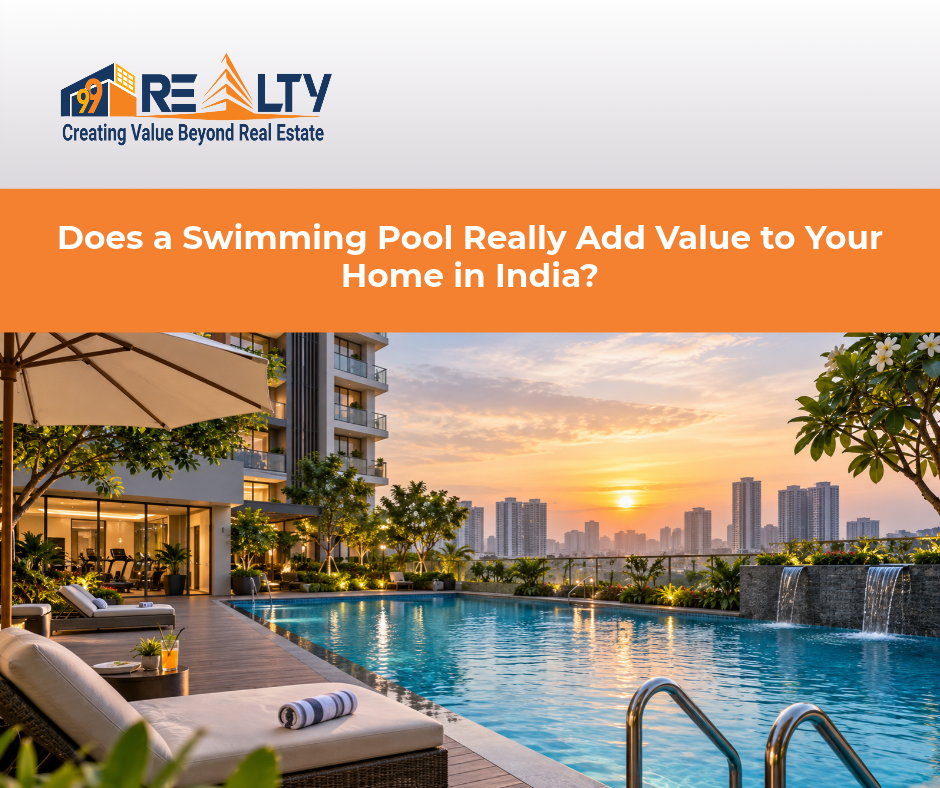
Picture yourself walking into a new residential project.
There’s a landscaped entrance, a stylish clubhouse, a gym—and then you see it: a sparkling swimming pool surrounded by deck chairs and greenery.
It immediately changes the way the property feels.
The project suddenly looks more premium. More aspirational. More like a resort than a conventional housing complex.
But here’s the question that deserves more attention:
Does that swimming pool actually make your home more valuable?
The answer depends on what you mean by “value.”
Because in Indian real estate, the value of a swimming pool isn’t simply about adding up the cost of constructing one. It is about how much buyers value the experience, convenience and lifestyle that come with it.
And sometimes, there can be a significant difference between the two.
The Pool Is Selling a Lifestyle
For developers, a swimming pool is rarely marketed as just a place to swim.
It is part of a lifestyle story.
A Sunday morning swim. Children learning to swim within the community. An evening spent beside the pool. A resort-like environment without having to travel to one.
This is particularly relevant as gated communities become increasingly amenity-driven.
Swimming pools now appear alongside gyms, clubhouses, sports courts, landscaped gardens, children’s play zones and wellness spaces. Current Indian housing listings show swimming pools being positioned as part of the broader lifestyle package across apartments and villas in markets such as Greater Noida, Gurgaon and Pune.
But there’s a catch.
A lifestyle amenity only creates meaningful value when the lifestyle actually works.
A Pool Doesn’t Automatically Mean a Higher Property Price
This is perhaps the most important point for a buyer.
There is no universal rule saying:
“Property with a swimming pool = X % higher value.”
Real estate doesn’t work that neatly.
Two apartments in the same city can have swimming pools and still command very different prices because of their location, floor plan, construction quality, developer, connectivity, density, views and overall project positioning.
A pool is therefore better understood as a supporting feature, rather than an independent price calculator.
In a luxury villa, a private pool could be a major differentiator.
In a 2,000-unit apartment community, a common pool may be just one element among dozens.
The financial impact can therefore be very different.
The Indian Apartment Pool Has a Unique Problem
Imagine a project with 200 apartments.
The brochure says:
“World-class swimming pool.”
Sounds impressive.
But what happens when hundreds of residents move in?
Suddenly, pool size matters.
Operating hours matter.
Access rules matter.
Peak-time crowding matters.
Even the ratio of residents to recreational facilities matters.
Recent reporting on large Indian housing societies has highlighted this exact issue: some residents find shared amenities difficult to use because the facilities are small relative to the community’s population, while others have raised concerns about inadequate maintenance despite continuing to pay for these facilities.
This creates what could be called the amenity paradox:
The more residents a project has, the more valuable shared amenities can appear on paper—but the harder they can become to use comfortably.
From Cleanliness to Community: 5 Ways Indian Societies Can Live Better Together
The Hidden Price of That Blue Water
Buying the apartment is only the beginning.
Someone has to maintain the pool.
Water needs treatment. Filters need servicing. Pumps consume electricity. The area needs cleaning. Equipment eventually needs replacement. Safety arrangements and staffing may also be required.
Those costs eventually find their way into the community’s operating expenses.
This matters because Indian homebuyers are increasingly looking beyond the purchase price and examining the long-term cost of living in a large gated development. Maintenance can include not only the pool but lifts, security, landscaping, power backup, water systems, sewage treatment plants and clubhouse operations.
So a buyer should not ask only:
“Does this project have a swimming pool?”
Ask:
“What will it cost me to have this swimming pool?”
When a Pool Can Make a Difference
A pool becomes more meaningful when it matches the property’s positioning and the expectations of its target buyer.
Premium and luxury homes
In a high-end development, buyers may be paying for an entire lifestyle ecosystem.
Here, an elegant pool can strengthen the property’s premium positioning alongside larger homes, better landscaping, club facilities, wellness spaces and privacy.
Family-oriented communities
For families with children, a swimming pool can be a genuine recreational advantage.
But parents should look beyond the photograph.
Is there a separate children’s pool?
Are safety arrangements adequate?
Are there trained personnel?
What are the timings?
These details determine whether the amenity is actually useful.
Health and fitness-focused buyers
For someone who swims regularly, proximity to a pool can have substantial practical value.
There is no commute to a swimming club. No separate membership may be required. And the facility is available within the residential community.
For someone who never swims, however, its value may be considerably lower.
What About Resale Value?
This is where buyers should be careful.
A swimming pool can potentially improve marketability because it gives a property an attractive feature to showcase.
But marketability and guaranteed price appreciation are not the same thing.
When you eventually sell, your property will compete against other homes.
If comparable projects offer better connectivity, larger homes, lower maintenance or newer facilities, a pool alone may not be enough to command a premium.
On the other hand, if your project is well maintained and the pool remains attractive and functional, it can contribute to the overall perception of the property.
In other words:
The pool may help sell the property—but the other factors of the property closes the deal.
Private Pool or Community Pool?
These are two very different propositions.
A private swimming pool offers privacy and exclusivity. In villas, luxury homes and select premium residences, that can become a genuine differentiator.
A community pool offers convenience and shared access.
You don’t have to build it yourself, but you also don’t control who uses it, how it is maintained or when it is available.
Therefore, buyers should never treat a private pool and a society pool as equivalent features when comparing properties.
Don’t Forget India’s Climate
The usefulness of a swimming pool also depends on where you live.
India’s climate varies enormously. A pool may be used very differently in Bengaluru, Mumbai, Delhi-NCR, Kolkata, Ranchi or Jaipur.
Seasonality, monsoon conditions, water availability and local weather patterns can all influence how frequently residents use the facility.
This is particularly important when evaluating a property in a region where swimming may be a seasonal activity.
A facility that looks impressive in summer may not have the same practical value throughout the year.
The 7 Questions Every Buyer Should Ask
Before paying extra for a home because of its swimming pool, ask:
1. How many residents will share it?
A beautiful pool can feel very different in a small community versus a mega township.
2. How large is it?
Don’t rely on promotional photographs. Look at actual dimensions.
3. What are the operating hours?
A pool you cannot use at convenient times has limited practical value.
4. What are the maintenance charges?
Find out whether pool-related expenses are included in regular maintenance or charged separately.
5. Who will maintain it after handover?
The developer may maintain a project beautifully during the sales period. What happens after the residents’ association takes over?
6. Is the promised amenity actually delivered?
Verify the project’s formal documents and approvals rather than relying only on marketing material.
7. Will you actually use it?
This might be the most important question of all.
The Broader Lesson: Buy Value Not Just Amenity
A long list of amenities can make a property brochure look impressive.
Swimming pool.
Gym.
Clubhouse.
Jacuzzi.
Sports courts.
Party lawn.
Kids’ zone.
But more amenities don’t automatically mean a better home.
The real question is whether those facilities are usable, maintainable and relevant to the people living there.
A recent Economic Times report on large housing societies highlighted the risk of residents paying for amenities that they rarely use or that become difficult to maintain as communities age.
That’s why the smartest approach is to evaluate the whole residential ecosystem.
Look at the location.
Look at connectivity.
Look at construction quality.
Look at water availability.
Look at maintenance.
Look at density.
Look at the developer’s track record.
Then look at the amenities.
So, Is a Swimming Pool Worth Paying More For?
It can be—but don’t assign it a value in isolation.
For one homebuyer, the pool could be something they use several times a week and genuinely enjoy.
For another, it could be an attractive feature that sits unused for most of the year.
For an investor, it may matter primarily because it improves the property’s appeal to prospective tenants.
There is no single answer for every Indian property.
The better question is:
Does the swimming pool improve the overall value proposition of this particular home?
If the answer is yes—and the additional price and maintenance costs make sense—then the pool can be a meaningful advantage.
If not, don’t let a beautiful poolside photograph make the decision for you.
99Realty Takeaway
A swimming pool can add lifestyle appeal, but the real value of a home lies far beyond the water.
The best residential project isn’t necessarily the one with the longest amenities list.
It is the one where location, livability, quality, affordability and amenities come together in a way that makes sense for you.
Because when the brochure disappears and you finally receive the keys, you won’t be living inside the amenity list.
You’ll be living in the home.
Need Help?
Need help evaluating a property or planning your next move in the market?
Reach out to 99 REALTY – your trusted real estate partner for smarter choices.
Subscribe to get updates on our latest posts and market trends.



Join The Discussion