

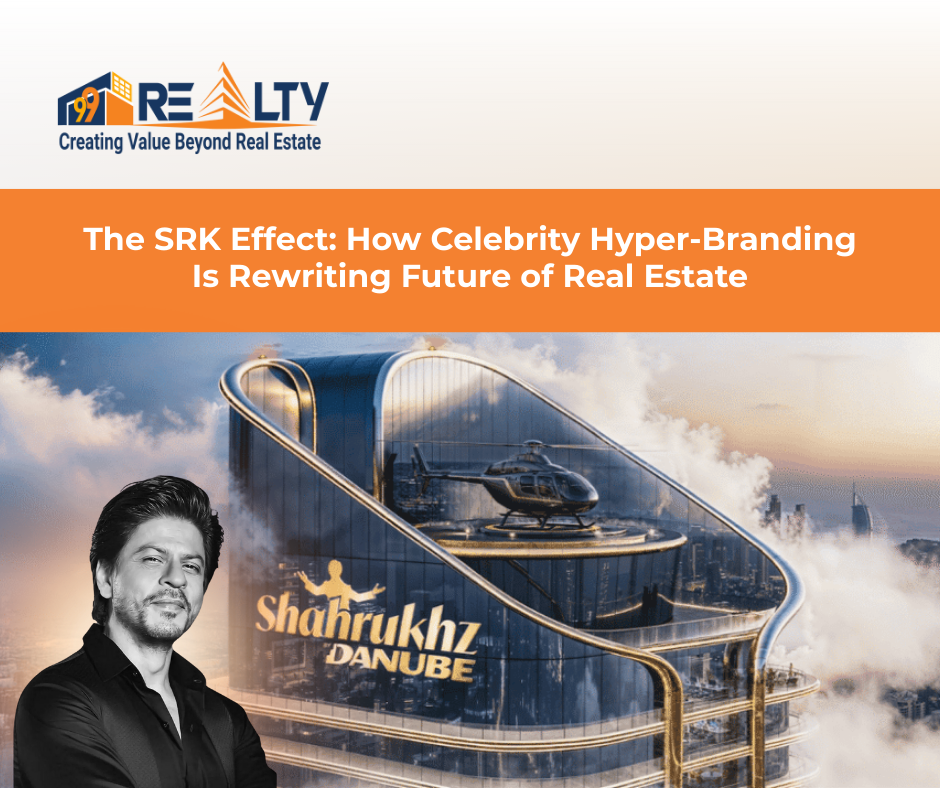
Let’s be honest — we’ve seen celebrities endorse everything: colas, credit cards, fairness creams, insurance, bikes, banks, you name it. But naming an entire ₹4,000-crore Dubai commercial tower after Shah Rukh Khan?
That’s not marketing.
That’s metamorphosis.
We’re entering an era where real estate isn’t just property — it’s identity. It’s lifestyle. It’s emotional capital. And Shah Rukh Khan just became the face of the movement.
Understanding Hyper-Branding
Hyper-branding in real estate represents a strategic shift from surface-level celebrity promotion to deeply embedding a celebrity’s reputation, values, and emotional resonance into the very DNA of a development. Instead of hiring a star for a temporary campaign, developers are now licensing celebrity identities and naming entire towers and communities after them—so the project permanently carries their influence. This creates a long-term aspirational pull, where ownership isn’t just about acquiring property, but about affiliating with the stature, success, and lifestyle that the celebrity embodies. Hyper-branding elevates real estate into a cultural and emotional commodity—properties become symbols of identity, prestige and belonging, appealing especially to HNIs, NRIs, and luxury-seeking buyers who desire not just a space to occupy, but a legacy to align with.
Emerging Real Estate Hotspots in India: Key Drivers and Future Prospects
From Ads to Assets
Traditional celebrity endorsements function like short-lived bursts of attention—eye-catching but fleeting, much like fireworks that brighten the sky briefly and then disappear. A celebrity poses for a campaign, delivers a scripted pitch, and the association fades once the contract expires or another face replaces them.
Hyper-branding, however, builds a foundation of lasting value. It’s not about renting a celebrity’s influence—it’s about embedding it into the property itself. Instead of asking a celebrity to sell a property, developers now create the property around the celebrity’s mythos.
The building becomes an extension of the star’s image—luxurious, ambitious, global, aspirational—turning the asset into something emotionally desirable, socially symbolic, and perpetually branded.
Why Names Create Permanent Value
A building named “Shah Rukhz” won’t fade when the ad campaign ends.
The name becomes the brand,
the brand becomes the identity,
and the identity becomes the premium.
How Hyper-Branding Will Reshape Marketing and Budget Allocation
Hyper-branding fundamentally shifts how marketing budgets are spent. Instead of funneling massive funds into recurring ad campaigns, celebrity appearances, seasonal billboards, influencer tie-ups, and media rotations, developers invest upfront into a single powerful identity anchor—the celebrity licensing itself. Initially, the cost of associating a celebrity’s name with a project may seem high, but it drastically reduces long-term promotional expenses.
Moreover, the branded identity creates organic PR and word-of-mouth amplification—news outlets cover it, social media discusses it, and buyers become evangelists. In effect, marketing evolves from “paying for attention” to “owning attention,” where the property becomes a cultural landmark rather than just another listing. Over time, this approach not only stabilizes marketing costs but also boosts ROI by attracting higher-value clientele willing to pay a premium for association. Hyper-branding doesn’t just change budgets—it changes the psychology of demand.
The Shah Rukhz Tower in Dubai
₹4,000 Crore Statement of Prestige
This isn’t some mid-market release — this is a declaration.
A ₹4,000 crore commercial mega-development that says:
“This is not real estate — this is a tribute.”
SRK as an Everlasting Brand Identity
For over 30 years, SRK hasn’t just been a star — he’s been a global phenomenon.
He stands for aspiration, romance, charm, hustle, and success.
When buyers invest, they’re not just purchasing square footage —
they’re buying emotional inheritance.
The Shift From Endorsement to Licensing
Old Way: Temporary Campaigns
Put a superstar on a billboard.
Run it for 6 months.
Sales spike.
Everyone moves on.
New Way: Permanent Naming Rights
Put a superstar’s name on a building.
It lives beyond marketing cycles.
It lives beyond brand lifetimes.
Honestly, it may even live beyond the celebrity themselves.
Rise of Celebrity-Branded Developments in India
What Indian Developers Are Learning
Developers in India are beginning to understand that buyers at the luxury and ultra-luxury levels are not just investing in a physical unit—they are investing in symbolic capital. A branded development can:
- command higher per-square-foot prices,
- attract NRI and HNI buyers more easily,
- create media-driven visibility without sustained advertising, and
- foster a perception of exclusivity and social elevation.
This learning is already influencing design language, facility planning, naming conventions, and narrative-driven marketing approaches.
Japan’s Piezoelectric Floor Tiles: Can It Solve India’s Energy Crisis?
The Expected Future of Identity-Based Real Estate
What we are likely to see is not arbitrary celebrity naming, but strategic alignment:
- A wellness-focused celebrity aligning with a wellness-centric residence,
- A business-icon figure pairing with commercial business hubs,
- A fashion or lifestyle personality partnering with boutique luxury living spaces.
This isn’t about random star association — it’s about emotional congruence between the celebrity’s perceived persona and the core identity of the development.
The Emotional Hierarchy of Luxury Purchases
Luxury real estate follows a clear behavioral pattern:
- In premium markets, emotion influences purchase.
- In ultra-premium markets, identity influences purchase.
- In hyper-luxury markets, association and affiliation influence purchase.
Buyers aren’t simply choosing a property—they are choosing a social narrative attached to themselves.
Psychology of Ownership — The Emotional Premium
Status Signaling for HNIs & NRIs
For global Indians who made it big in London, New York, Singapore, or Toronto…
Owning property with the name “Shah Rukh Khan” isn’t just a purchase —
It’s a statement:
“I’ve arrived.”
A Name is a Social Asset
Some people display watches.
Some display cars.
Some display real estate.
Owning a property named after SRK is the new Rolex for high-net-worth Indians.
Emotional Marketing in Commercial Real Estate
From “Office Space” to “Lifestyle Workplace”
Instead of:
“Here’s world class office space with meeting rooms.”
We will hear:
“Here’s a business environment shaped by a leading business icon—designed to inspire ambition, achievement and long-term success.”
Branding Work Environments
Modern workplaces are no longer just functional areas filled with desks and partitions—they are intentionally crafted environments that signal innovation, culture, and purpose. Today’s branded offices embody a conceptual narrative: they communicate ambition, foster collaboration and promote a sense of belonging among employees and stakeholders. These environments transform from mere square footage into experiential ecosystems where architecture, aesthetics, and brand identity intersect to create spaces that reflect the organization’s values and vision.
Risks & Critiques of Hyper-Branding
Celebrity Risk Exposure
If the celebrity falls out of favor — the brand carries the burden.
Not likely with SRK — but possible with others.
Over-Commercialization
There is a danger of:
- Too many named properties
- Diluted brand value
- Turning celebrity identity into architectural wallpaper
Unique Reputation Hazard
A structural crack isn’t just a construction issue — it becomes a celebrity credibility issue.
A delayed handover becomes a headline.
A design flaw becomes a viral meme or controversy.
In hyper-branding, the celebrity is not merely an ambassador — they become a symbolic co-owner of the promise made to buyers. Their personal brand equity is effectively “on the line.” This is why hyper-branded developments must prioritize engineering integrity, lifecycle durability, safety certifications, and long-term performance not just aesthetics and publicity.
Why This Trend is Unstoppable
Future of Real Estate Branding
Because humans don’t just buy property.
They buy meaning.
They buy narrative.
They buy emotional landmarks.
India’s Global Luxury Market Evolution
India is becoming richer, more confident, and more expressive.
And expressive wealth wants expressive property.
How Real Estate Looks Boring but Builds Real Wealth
Conclusion
The ₹4,000-crore Shah Rukhz tower in Dubai isn’t just another skyscraper — it’s a cultural milestone. It represents a shift where celebrities aren’t just endorsing brands — they are the brand. Hyper-branding changes real estate from a financial transaction into an emotional, symbolic, aspirational purchase. And make no mistake — this is only the beginning.
FAQs
1. What is Hyper-Branding in real estate?
It’s when a celebrity’s name becomes permanently attached to a property, creating a long-term emotional and brand identity.
2. Why is the Shah Rukhz tower such a big deal?
Because it’s one of the world’s first major commercial hyper-branded real estate ventures linked to an Indian icon.
3. Will India adopt this trend widely?
Absolutely — Indian developers already see the emotional and financial leverage such branding provides.
4. Does celebrity branding increase property value?
Yes — it creates scarcity, desirability, and emotional pull, which leads to premium pricing.
5. Could hyper-branding backfire?
Only if the celebrity’s reputation declines or if the market becomes oversaturated with similar projects.
Need Help?
Need help evaluating a property or planning your next move in the market?
Reach out to 99 REALTY – your trusted real estate partner for smarter choices.
Subscribe to get updates on our latest posts and market trends.

Join The Discussion