

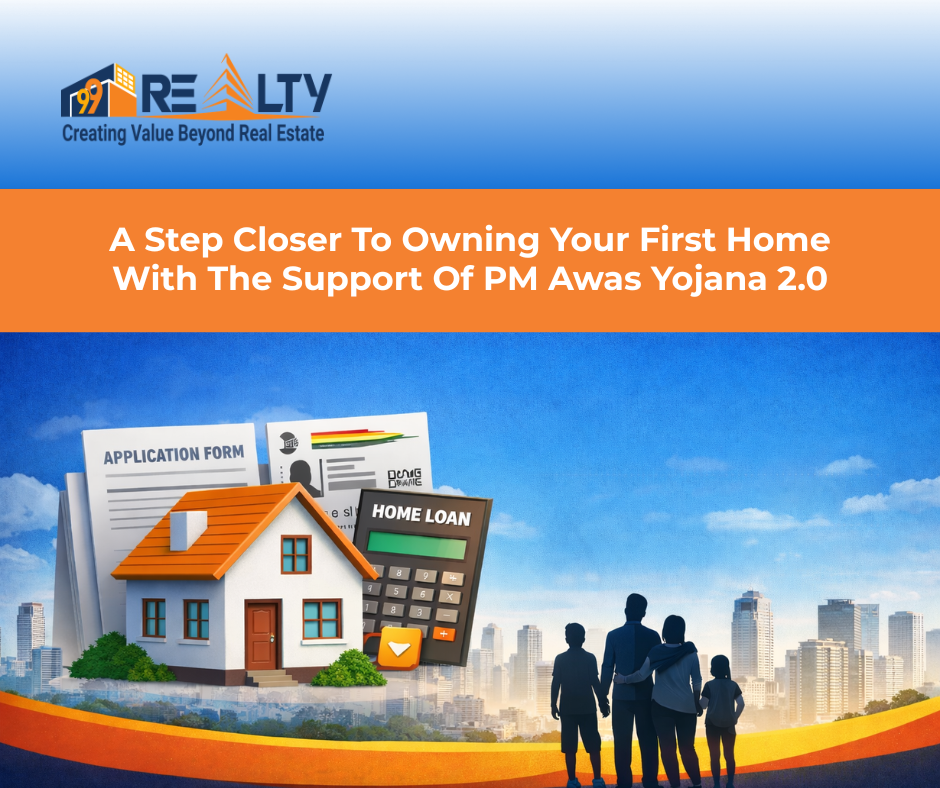
Imagine earning ₹40,000 a month, paying rent regularly, and watching property prices move further away every year. You have a steady job, a growing family, and a simple dream — a home of your own.
For millions of Indians, this isn’t a hypothetical situation. It’s everyday reality.
To address this gap between rising property prices and affordability, the Government of India launched Pradhan Mantri Awas Yojana (PMAY) under the vision of “Housing for All.” The latest phase — PM Awas Yojana 2.0 (PMAY 2.0) — expands the mission and continues supporting families who want to own their first home.
If you are planning to buy a house, here is a clear guide to who qualifies for PMAY 2.0 and how you can apply in 2026.
Affordable Homes Now Possible With 3D Printing in India?
What Is PM Awas Yojana 2.0?
PMAY 2.0 is the updated phase of the government’s flagship housing program that originally began in 2015.
The scheme continues to support affordable housing through two main verticals:
PMAY-Urban (PMAY-U)
Designed for families living in cities and urban areas. The main benefit comes in the form of an interest subsidy on home loans, reducing the overall EMI burden.
PMAY-Gramin (PMAY-G)
Focused on rural households that do not own a pucca house. Eligible beneficiaries receive direct financial assistance to construct or upgrade their homes.
The goal of the scheme remains simple:
help families without permanent housing own a safe and affordable home.
Who Is Eligible for PMAY 2.0?
Eligibility for the scheme depends mainly on household income and housing status.
Income Categories
| Category | Annual Household Income |
|---|---|
| EWS (Economically Weaker Section) | Up to ₹3 lakh |
| LIG (Low Income Group) | ₹3–6 lakh |
| MIG (Middle Income Group) | ₹6–9 lakh |
The scheme primarily targets lower and middle-income households looking to purchase their first home.
Basic Eligibility Conditions
To qualify for PMAY benefits, applicants must meet the following criteria:
- The applicant must be an Indian citizen.
- The family must not own a pucca house anywhere in India.
- The family should not have previously received benefits under PMAY.
- Only one application per family is allowed (husband, wife, and unmarried children).
- Aadhaar identification is required for verification and benefit transfer.
- For PMAY-Urban, the property should be located within eligible urban or notified town areas.
Women and PMAY
One notable feature of PMAY is its focus on encouraging women’s property ownership.
For many beneficiaries under EWS and LIG categories, the property is encouraged to be registered in the name of a female member or jointly with a male member. This step aims to strengthen financial security and promote gender equality in property ownership.
How Much Benefit Can You Receive?
Under PMAY-Urban, eligible homebuyers can receive an interest subsidy of up to ₹1.80 lakh on their home loan.
Key points about the subsidy:
- The subsidy is calculated as a Net Present Value (NPV) of around ₹1.50 lakh.
- It is credited directly to the home loan account.
- This reduces the principal amount of the loan, lowering the EMI burden.
For PMAY-Gramin beneficiaries, the government provides financial assistance for housing construction:
- ₹1.20 lakh in plain areas
- ₹1.30 lakh in hilly or difficult regions
These funds are transferred directly to the beneficiary’s Aadhaar-linked bank account through DBT (Direct Benefit Transfer).
Documents Required for PMAY Application
Before applying, keep the following documents ready:
- Aadhaar card
- PAN card
- Income proof (salary slips, Form 16, or IT returns)
- Bank account details
- Address proof
- Property documents or allotment letter
- Passport-size photographs
- Self-declaration stating that the family does not own a pucca house
If applicable, applicants may also need:
- Caste certificate (SC/ST categories)
Having these documents prepared can help ensure a smoother application process.
How to Apply for PMAY 2.0 in 2026
The application process differs slightly for urban and rural applicants.
PMAY-Urban Application (Online)
Follow these steps:
- Visit the official portal: pmaymis.gov.in
- Click on Citizen Assessment.
- Enter your Aadhaar number for verification.
- Fill in personal, income, and property details.
- Upload the required documents.
- Submit the form and note your application number for tracking.
Applicants can also visit a Common Service Centre (CSC) for assistance if they are not comfortable applying online.
PMAY-Gramin Application
For rural households, the process usually involves local authorities.
Steps include:
- Visit the Gram Panchayat office or Block Development Office.
- Register through the Awaas+ mobile survey system.
- Local officials verify housing conditions and eligibility.
Once approved, financial assistance is transferred directly to the beneficiary’s bank account.
How to Check Your PMAY Application Status
Applicants can track their application status online.
For PMAY-Urban
- Visit pmaymis.gov.in
- Click Search Beneficiary
- Enter your Aadhaar number or application number
For PMAY-Gramin
- Visit pmayg.nic.in
- Navigate to Stakeholders → PMAY-G Beneficiary
- Search using your registration details
Beneficiary lists are updated periodically as verification processes are completed.
Common Mistakes to Avoid
Many applicants face delays due to simple mistakes. Avoid these issues:
- Applying through unofficial websites or agents
- Aadhaar not linked to the bank account
- Incorrect income documentation
- Applying for a property outside eligible urban limits
- Providing incomplete family ownership details
The application process for PMAY is free, and beneficiaries should rely only on official government portals or authorized service centers.
Why PMAY Matters for First-Time Homebuyers
With rising property prices across many Indian cities, government housing support programs like PMAY play an important role in improving affordability.
For first-time buyers, the interest subsidy can significantly reduce the financial burden of a home loan. Combined with growing real estate development in cities such as Ranchi, Dhanbad, Jamshedpur, Lucknow, and Noida, affordable housing opportunities are becoming more accessible than before.
For many families, PMAY is not just a subsidy — it is a step closer to owning a first home.
Final Checklist Before Applying
Before starting your PMAY application, make sure:
✅ Your household income falls within eligible limits
✅ Your family does not own a pucca house in India
✅ You have not previously received PMAY benefits
✅ Aadhaar is linked to your bank account
✅ All required documents are ready
✅ The property is located in an eligible area
Disclaimer: The information provided in this article is for general awareness and informational purposes only. Government policies, eligibility criteria, and subsidy benefits under Pradhan Mantri Awas Yojana (PMAY) may change over time based on official notifications. Readers are advised to verify the latest guidelines through the official PMAY portals or relevant government authorities before applying. 99Realty does not guarantee eligibility or approval under the scheme and is not affiliated with the Government of India.
Need Help?
Need help evaluating a property or planning your next move in the market?
Reach out to 99 REALTY – your trusted real estate partner for smarter choices.
Subscribe to get updates on our latest posts and market trends.


Join The Discussion