

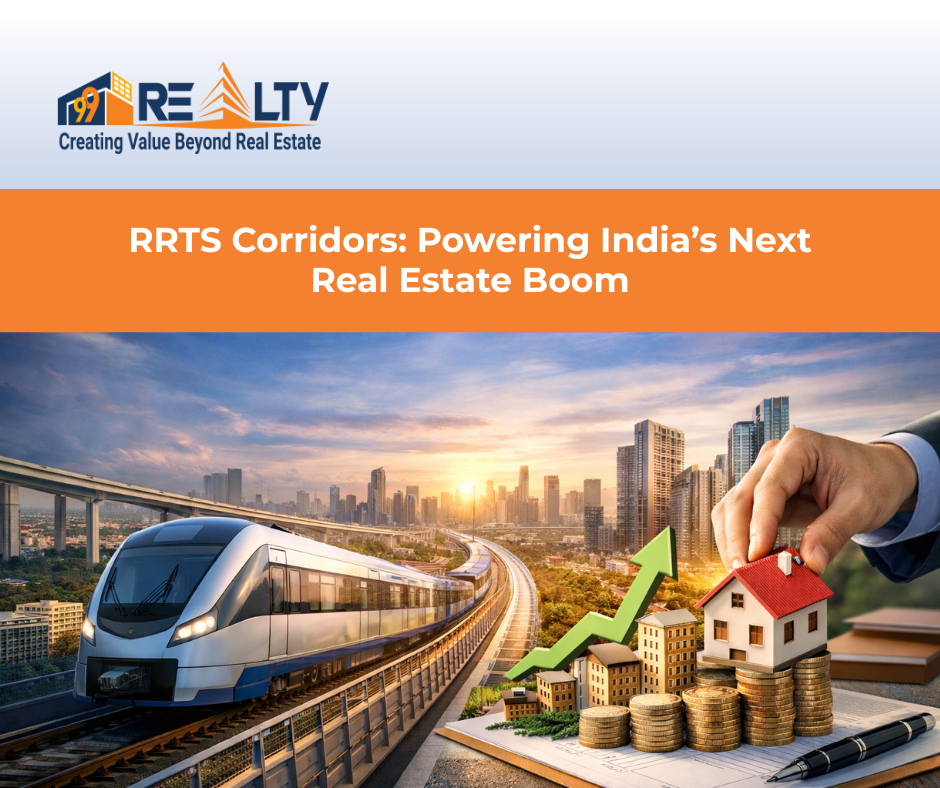
India is not just building roads and railways anymore — it’s engineering growth corridors. And at the heart of this transformation lies the Regional Rapid Transit System (RRTS).
If highways were the growth engines of the 2000s and metro rail defined the 2010s, RRTS is the wealth-creator of the next 20 years — especially for real estate.
Let’s break it down simply, honestly, and practically — so you know how to plan property buying near RRTS corridors and why it could be one of the smartest decisions of your lifetime.
What Is RRTS and Why It Matters for India
Understanding the Regional Rapid Transit System (RRTS)
The Regional Rapid Transit System (RRTS) is one of India’s most ambitious next-generation transport initiatives, created to bridge the gap between mega cities and their surrounding towns. Unlike traditional rail or metro systems that focus mainly on city-level movement, RRTS is designed for regional mobility — connecting cities and satellite towns spread across a 100–250 km radius.
In simple terms, RRTS brings metro-like convenience to intercity travel. It combines the speed of express trains with the frequency, comfort, and reliability of urban metro systems. This means commuters no longer have to choose between slow local trains, unpredictable road travel, or expensive private transport.
What truly sets RRTS apart is its high operational speed and consistency. Trains are engineered to run at 140–180 km/h, drastically shrinking travel times. Journeys that earlier took 2–3 hours by road — often stretched further by congestion — are now completed in just 45–60 minutes, with predictable schedules and minimal delays.
Beyond speed, RRTS is built for daily commuting at scale. Features such as:
- High-frequency services
- Comfortable seating for longer journeys
- Dedicated tracks free from traffic interference
- Seamless integration with metro, buses, and last-mile transport
make it a practical solution for professionals, students, and businesses alike.
Most importantly, RRTS is not just a transport upgrade — it is a structural shift in how India moves, lives, and grows. By collapsing distances between cities and towns, it enables people to live farther away without sacrificing time, productivity, or quality of life — laying the foundation for new urban centres, balanced regional development, and massive economic growth.
Why Tier 2 and Tier 3 Cities Are the New Investment Frontiers
The Big Vision: Why India Is Betting Big on RRTS
Reducing Travel Time Between Mega Cities
When distance collapses, opportunity expands—and this single idea sits at the core of India’s RRTS vision.
For decades, Indian cities grew in a lopsided manner. Jobs, capital, and infrastructure clustered inside a few expensive metros, while surrounding towns remained underutilised. The result? Long commutes, unaffordable housing, choking congestion, and declining quality of life.
RRTS directly attacks this imbalance.
By enabling high-speed, predictable travel between mega cities and nearby towns, RRTS allows professionals to live in more affordable, less congested locations while continuing to work in high-value urban centres. What earlier required a painful 2–3 hour road journey—often unpredictable and exhausting—can now be done in 45–60 minutes of smooth, reliable travel.
This is not just about saving time. It is about redefining daily life. Time saved translates into better work-life balance, higher productivity, and healthier urban living. In effect, RRTS turns distance into a non-issue, unlocking entire regions that were earlier considered “too far” to matter.
Boosting Economic Clusters and Job Creation
One of the most underappreciated strengths of RRTS is how it creates economic gravity around every station.
An RRTS station is not merely a transit stop—it is a future economic nucleus. Over time, these stations organically attract offices, housing developments, retail centres, logistics hubs, educational institutions, and healthcare facilities. The ecosystem grows layer by layer, feeding off improved accessibility and rising footfall.
This decentralisation is not accidental. It is a deliberate policy choice to move India away from hyper-congested city cores toward a network of self-sustaining urban clusters. Jobs no longer need to be concentrated in one expensive downtown. Talent no longer needs to migrate endlessly into metros. Economic activity begins to spread more evenly across regions.
The impact is powerful:
- New employment hubs
- Balanced regional growth
- Reduced migration pressure on metros
- Sustainable urbanisation
In the long run, RRTS stations become anchors of economic resilience, supporting both local livelihoods and national growth.
RRTS Corridors in India: Current Status (2026)
India’s RRTS story is no longer theoretical—it is actively unfolding.
Operational and Under-Construction Corridors
The most advanced example is the Delhi–Meerut corridor, part of India’s Namo Bharat Regional Rapid Transit System (RRTS), is a high-speed rail line connecting Delhi, Ghaziabad, and Meerut which are already operational. This corridor has become a live case study of how faster connectivity reshapes commuting patterns and real estate demand almost immediately.
Other key corridors under development or planning include Delhi–Alwar and Delhi–Panipat, both strategically designed to integrate industrial towns, residential hubs, and employment centres with the national capital region.
Beyond North India, serious groundwork is underway in the Mumbai Metropolitan Region, while Bengaluru’s regional connectivity plans are in advanced planning stages. These corridors are already influencing land demand, even before full-scale execution.
The pattern is clear: once a corridor is announced, the market moves first—often faster than policy execution.
Upcoming and Proposed Corridors
Looking ahead, rapid announcements are expected across major growth-driven states such as Maharashtra, Gujarat, Tamil Nadu, Karnataka, and the Punjab–Haryana belt. These regions combine high population density, industrial activity, and expanding urban footprints—making them ideal candidates for RRTS-led development.
Government thinking is now firmly aligned around one principle:
future urban growth must be rail-led, not road-choked.
With land scarcity and traffic congestion reaching unsustainable levels, RRTS is emerging as the backbone of India’s next urban chapter.
How RRTS Corridors Trigger 10x Real Estate Growth
The Infrastructure–Real Estate Multiplier Effect
Infrastructure does more than add convenience—it reshapes value itself.
When an RRTS corridor is announced, accessibility improves long before construction is complete. Improved accessibility attracts people. People attract demand. Demand attracts developers. And once quality supply enters the market, prices begin to move—often sharply.
This is not speculative theory; it is a well-documented cycle seen across global cities. What makes RRTS unique is the scale and speed at which this multiplier operates, especially in India’s high-growth environment.
Early-stage corridors typically offer the highest asymmetry—where downside risk is limited, but upside potential is substantial.
Land Value Appreciation Explained Simply
Imagine land as a smartphone without internet.
It works. It has basic utility. But its potential is capped.
RRTS is the high-speed internet connection.
The moment seamless connectivity arrives, everything improves at once—livability, desirability, commercial use, rental potential, and long-term appreciation. The same piece of land suddenly supports more value because time, access, and opportunity converge.
That is why infrastructure-led appreciation tends to be structural, not speculative.
Why Property Near RRTS Becomes Future Gold
Residential Demand Explosion
People don’t chase cities anymore.
They chase connectivity plus affordability.
Areas near RRTS stations naturally attract young professionals seeking better work-life balance, families priced out of metro cores, remote workers who value flexibility, and daily commuters who prioritise time efficiency.
Over time, this demand reshapes entire micro-markets, transforming once-overlooked suburbs into aspirational residential zones.
Commercial and Rental Yield Growth
Transit-driven locations consistently outperform traditional residential areas when it comes to rental demand. Retail outlets, co-working spaces, hostels, serviced apartments, and neighbourhood offices all thrive around high-footfall transit nodes.
Historically, properties near major transit corridors have delivered stronger and more stable rental yields, supported by constant demand rather than market hype.
Who Should Buy Property Near RRTS Corridors
End-Users (Homebuyers)
For homebuyers seeking a better lifestyle—without paying metro-core premiums—RRTS zones offer a compelling proposition. Faster commutes, modern developments, better planning, and long-term appreciation make these locations future-ready places to live, not just invest.
Investors and Long-Term Wealth Builders
For investors with a 5–10 year horizon, RRTS corridors represent asymmetric opportunities. Entry prices remain relatively reasonable during early phases, while long-term demand visibility is unusually strong. This combination is rare—and valuable.
How to Plan Property Buying Near RRTS (Step-by-Step)
The smartest buyers focus on location intelligence, not just proximity. A distance of 1–3 km from an RRTS station typically offers the best balance—close enough for convenience, far enough to avoid congestion and noise premiums.
Equally important is due diligence. Always verify zoning status, development plans, government notifications, and approval records. Infrastructure corridors attract both serious developers and opportunistic speculators. The difference between wealth creation and wealth erosion lies in verification.
New Property Buyers Top Checklist for Site Visit
Current Market Conditions Near RRTS Corridors
At present, prices in many RRTS-linked locations are rising steadily but remain rational. Early-stage corridors still provide entry-level opportunities, while institutional investors are quietly building positions—often a strong signal of long-term confidence.
Risks exist, of course, but they are largely manageable. Project delays are mitigated through phased execution, liquidity improves post-operational stages, and overpricing is usually limited to heavily hyped pockets.
Future Prospects: 5–10 Year Outlook
RRTS will not merely expand existing cities—it will create new urban cores. Growth will increasingly happen along corridors rather than outward in uncontrolled sprawl. This shift will define India’s urban geography for decades.
Mistakes Buyers Must Avoid
The biggest mistakes are emotional ones: buying on hype, ignoring connectivity plans, overpaying for unapproved projects, or expecting short-term flips. RRTS rewards patience, planning, and perspective—not speculation.
Final Thoughts: Is RRTS the Smartest Property Bet of the Decade?
Yes—when approached with clarity and discipline.
RRTS is not just a transport upgrade. It represents economic redistribution, urban rebalancing, and wealth migration at a national scale. Those who understand this shift early don’t merely buy property—they secure time, access, and future demand.
And in real estate, that is where real wealth is quietly built.
Disclaimer: The information provided in this article is published by 99Realty for general awareness and educational purposes only. While every effort has been made to ensure accuracy, market conditions, government policies, and infrastructure timelines may change. This content should not be construed as legal, financial, or investment advice. Readers are encouraged to independently verify details and consult relevant professionals before making any real estate decisions.
Need Help?
Need help evaluating a property or planning your next move in the market?
Reach out to 99 REALTY – your trusted real estate partner for smarter choices.
Subscribe to get updates on our latest posts and market trends.


Join The Discussion