

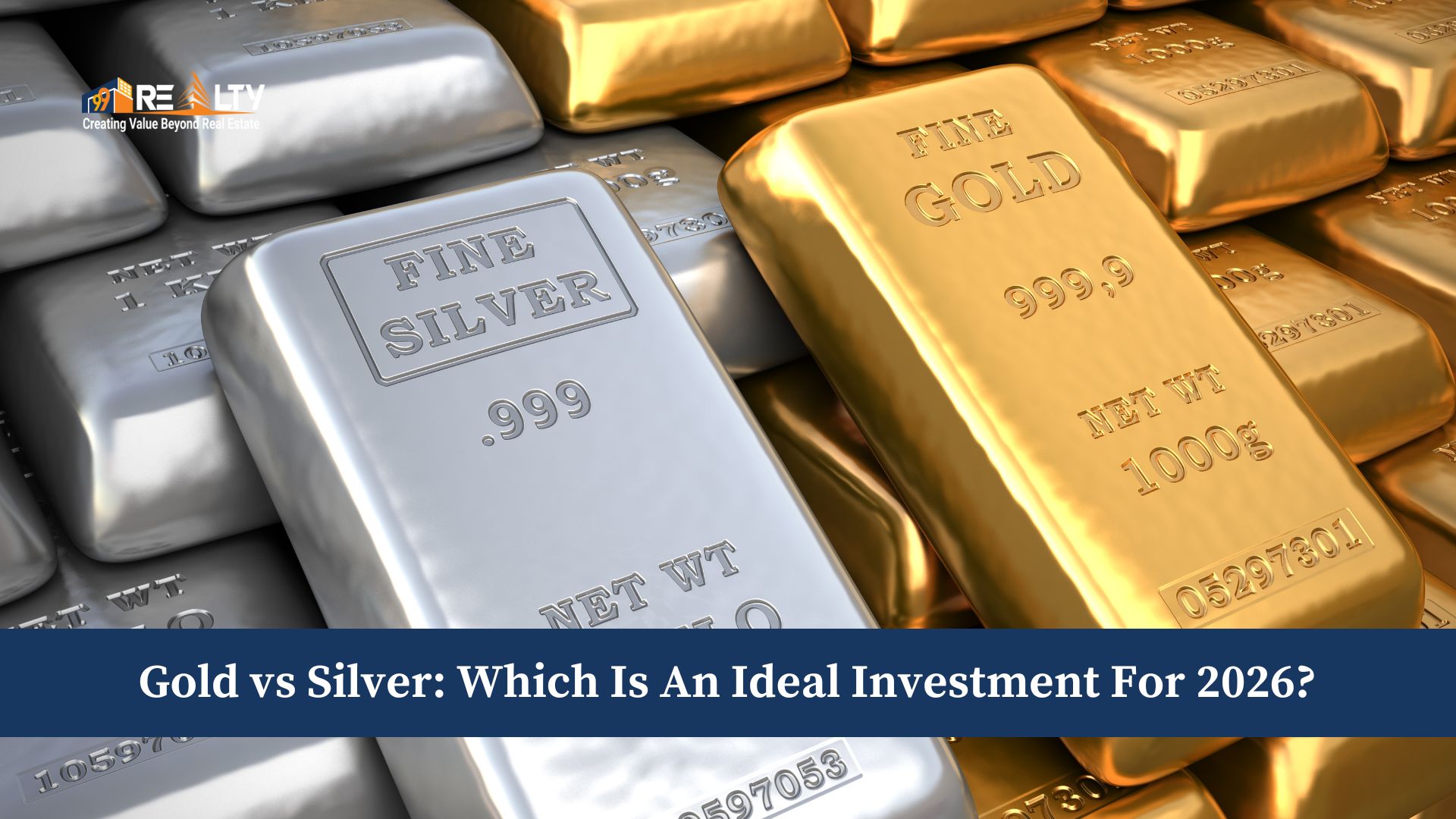
Precious metals have always played a distinct role in investment portfolio. They are not growth assets in the conventional sense, nor are they purely defensive instruments. Instead, gold and silver sit at the intersection of wealth preservation, inflation hedging, and portfolio diversification.
As 2026 approaches, investors are once again weighing a familiar question: gold or silver, which offers a better investment opportunity? The answer depends less on which metal is “better” and more on what role the investment is expected to play.
How Real Estate Diversification Protects Your Investment Portfolio
Understanding the Fundamental Difference Between Gold and Silver
Gold and silver may both be precious metals, but they behave very differently.
Gold is primarily a monetary and reserve asset. Its demand is driven largely by central banks, long-term investors, and jewelry consumption. It tends to perform well during periods if economic uncertainty, currency depreciation, and geopolitical stress.
Silver, on the other hand, is a hybrid metal. Along with its investment and jewelry demand, a significant portion of silver consumption comes from industrial uses such as electronics, renewable energy, electric vehicles, and medical equipment. This makes silver more sensitive to economic growth cycles.
Historical Performance and Volatility
Historically, gold has delivered steady, lower-volatility returns over long periods. It rarely experiences sharp crashes, but it also does not produce rapid price spikes unless there is a major macroeconomic trigger.
Silver has shown higher volatility. In bullish phases, it often outperforms gold on a percentage basis. However, during downturns, silver tends to fall more sharply due to its industrial demand exposure.
For investors, this means gold is typically better suited for stability, while silver introduces higher risk and potentially higher reward.
Industrial Real Estate’s New King: Manufacturing Leasing
Outlook for Gold in 2026
Gold’s investment case for 2026 rests on a few structural factors.
First, central banks across the world have been increasing their gold reserves over the last few years as a hedge against currency risk and geopolitical uncertainty. This trend has strengthened gold’s role as a reserve asset.
Second, global interest rate trajectories remain uncertain. Even if rates stabilise or decline, inflation concerns are unlikely to disappear entirely. Gold historically performs well is such environments as a store of value.
Third, gold continues to act as a portfolio stabiliser. During periods of equity market volatility, gold often either holds value or moves inversely to risk assets, reducing overall portfolio drawdowns.
For investors prioritizing capital protection and long-term wealth preservation, gold remains highly relevant going into 2026.
Outlook for Silver in 2026
Silver’s outlook is more closely tied to global economic activity and technological adoption.
Demand from renewable energy, particularly solar panels, electric vehicles, and advanced electronics, is expected to remain strong. This structural industrial demand gives silver a growth-oriented angle that gold lacks.
However, silver’s reliance on industrial cycles also introduces risk. Any slowdown in global manufacturing or delays in energy transition investments can impact prices significantly.
Silver’s investment appeal in 2026 is therefore more opportunistic. It may deliver stronger returns in a global growth environment but comes with a higher volatility and short-term fluctuations.
Liquidity and Market Accessibility
Both Gold and Silver are highly liquid assets, available through physical forms, exchange-traded funds, digital platforms, and derivatives.
Gold markets are deeper and more stable, making it easier for large investors to enter and exit positions without significant price impact. Silver markets, while liquid, are smaller and therefore more sensitive to changes in demand and speculation.
This difference reinforces gold’s role as a core holding and silver’s role as a satellite or tactical allocation.
Inflation and Currency Protection
Gold has consistently demonstrated its ability to protect purchasing power over long periods. It performs particularly well during episodes of high inflation, currency depreciation, or loss of confidence in fiat systems.
Silver can also benefit from inflationary environments, but its performance is less consistent because industrial demand can weaken during economic stress, offsetting inflation-driven gains.
Taxation and Investment Structure Considerations
From a taxation perspective, both metals are treated similarly in many jurisdictions when held as physical assets or certain investment instruments. However, transaction costs, storage costs, and price spreads tend to be higher for silver due to its bulk and lower value density.
Gold is generally more efficient to hold for long durations, while silver is better suited for shorter to medium term positioning.
Which Is The Ideal Investment for 2026?
There is no single correct answer, but a clear framework emerges.
Gold is suited better for investors who:
- Seek portfolio stability and risk reduction
- Want protections against inflation and currency risk.
- Prefer lower volatility and long-term holding.
Silver is better suited for investors who:
- Are comfortable with higher volatility.
- Want exposure to industrial and technological growth themes.
- Are willing to take tactical positions based on economic cycles.
For many investors, the most balanced approach is not choosing one over the other, but allocating differently. Gold can form the core precious metals exposure, while silver can complement it as a higher risk, reward component.
Conclusion
As 2026 approaches, the gold versus silver debate is less about choosing a winner and more about aligning investments with intent. Gold and silver serve different purposes, respond to different economic forces, and reward different risk profiles. Expecting one metal to universally outperform the other oversimplifies a much more nuanced reality.
Need Help?
Need help evaluating a property or planning your next move in the market?
Reach out to 99 REALTY – your trusted real estate partner for smarter choices.
Subscribe to get updates on our latest posts and market trends.



Join The Discussion