

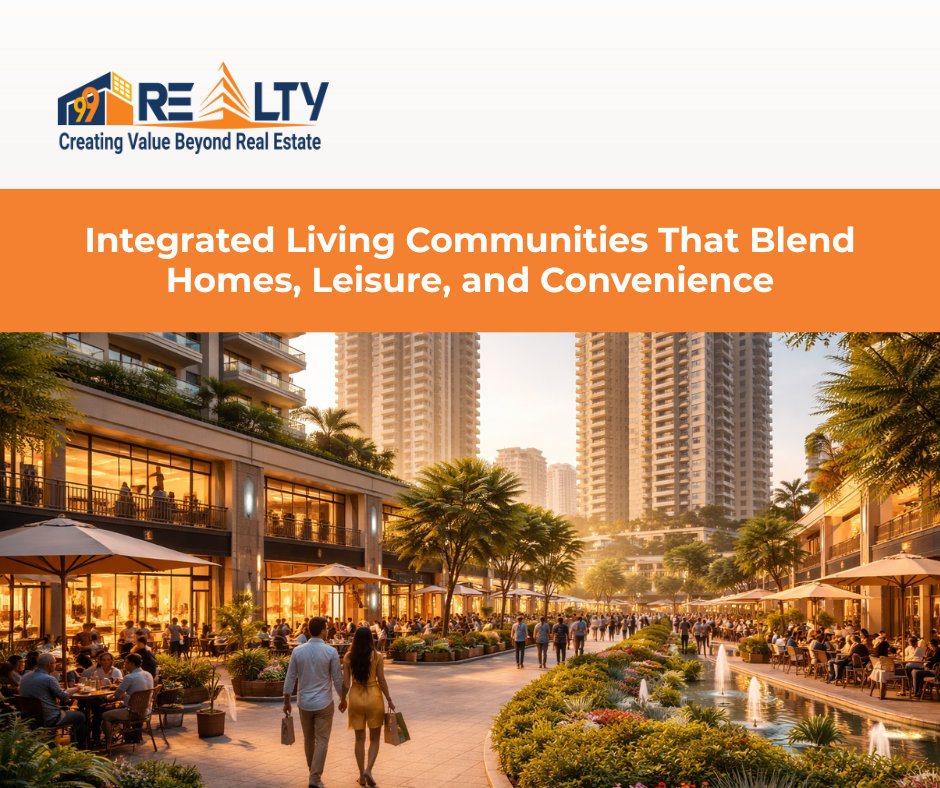
Luxury housing in India is undergoing a quiet but decisive transformation. For decades, premium real estate was defined by size, location, and surface-level opulence—bigger homes, prime addresses, imported fittings. Today, that definition is changing.
Modern luxury buyers are no longer asking how big a home is.
They are asking how well it fits into their life.
This shift has given rise to integrated living—a model where residential spaces are seamlessly combined with retail, leisure, workspaces, and social infrastructure. It is not just a design trend; it reflects a deeper change in how Indians want to live, work, and invest.
SOHO Explained: Why Small Office Home Office (SOHO) is the Next Big Trend in India
What Exactly Is Integrated Living?
Integrated living refers to mixed-use residential developments where homes coexist with curated lifestyle elements such as:
- High-street retail and cafés
- Wellness zones and fitness centres
- Entertainment and social spaces
- Offices or co-working hubs
- Walkable streets and open public areas
The goal is to create a self-sufficient micro-ecosystem, reducing dependence on external infrastructure while improving everyday convenience.
Importantly, not all mixed-use projects are equal. Integrated living today appears in four dominant formats:
- Retail-Led Developments – Homes supported by high-street retail and F&B zones
- Lifestyle-Led Communities – Focused on wellness, recreation, and social engagement
- Office-Integrated Projects – Designed for work-life proximity
- Large Integrated Townships – City-within-a-city models with full-scale infrastructure
Understanding this distinction is critical for buyers and investors alike.
Why Buyers Are Driving This Shift
While developers are actively promoting integrated living, the real catalyst is buyer behaviour.
1. Time Has Become the New Luxury
Urban buyers—especially professionals and business owners—are acutely aware of how much time is lost commuting for basic needs. Integrated developments offer:
- Walkable access to essentials
- Reduced daily travel
- More time for family, health, and leisure
In effect, a good integrated location gives time back, and time is now a premium currency.
2. Post-Pandemic Lifestyle Reset
The pandemic permanently changed how people view their homes:
- Homes became offices, gyms, cafés, and social hubs
- Access to safe outdoor and social spaces gained importance
- Buyers started valuing community over isolation
Integrated living addresses these needs by blending privacy with shared experiences.
3. A More Mature Definition of Luxury
Luxury buyers today are better informed and globally exposed. For them, luxury means:
- Quality of everyday experience
- Thoughtful planning
- Social and lifestyle convenience
- Long-term livability, not short-term glamour
This is why a well-planned integrated project often commands more attention than a standalone luxury tower.
The Investment Angle: Does Integrated Living Make Financial Sense?
From an investment perspective, integrated developments offer both advantages and caveats.
Potential Upsides
- Stronger long-term demand due to lifestyle appeal
- Higher rental desirability among professionals and expats
- Better resilience during market slowdowns
- Value appreciation driven by surrounding commercial activity
Unlocking the Secrets of Residential vs Commercial Property
Real Risks to Consider
- Higher entry prices compared to standalone projects
- Increased maintenance costs due to shared infrastructure
- Risk of over-commercialisation if poorly planned
- Noise, traffic, and crowd management challenges
A well-executed integrated project enhances value. A poorly executed one can dilute the residential experience. Execution quality matters more than the concept itself.
Developers Leading the New Wave
India’s top luxury real estate players are already embracing the integrated living model:
- DLF Homes is expanding into walkable high-street retail alongside residential towers, bringing urban lifestyle experiences into formats previously seen only in satellite cities.
- Hero Realty and M3M are building projects with seamless retail, leisure and residential interfaces that prioritise connectivity.
- Tribeca Developers are pairing boutique retail boulevards with high-end residences in Pune and beyond, enhancing both convenience and lifestyle appeal.
- Central Park and others are also embedding curated experiences — such as cafés, salons, and entertainment areas — into their luxury communities.
Across India’s major cities — from Delhi-NCR to Pune, Bengaluru and Mumbai — these integrated developments are gaining traction as the new benchmark for premium living.
What Developers Are Getting Right—and Wrong
Leading developers across NCR, Mumbai, Pune, and Bengaluru are actively adopting integrated formats. Many are:
- Designing walkable high-street retail instead of inward-facing malls
- Separating residential privacy from commercial footfall
- Curating tenant mixes instead of leasing indiscriminately
However, some projects misuse the “integrated” label without:
- Adequate infrastructure planning
- Traffic and density management
- Long-term community vision
Buyers must look beyond brochures and ask hard questions about layout, access control, and future scalability.
Integrated Living vs Standalone Luxury: A Practical Comparison
| Aspect | Integrated Living | Standalone Luxury |
|---|---|---|
| Convenience | High | Moderate |
| Lifestyle Access | Built-in | External |
| Community Living | Strong | Limited |
| Maintenance Costs | Higher | Lower |
| Privacy Control | Depends on design | Higher |
| Long-Term Value | Strong if executed well | Stable |
There is no universal winner. The right choice depends on life stage, usage intent, and personal priorities.
Is Integrated Living the Future of Indian Cities?
All indicators suggest yes—but with evolution.
As Indian cities grow denser and land becomes scarce:
- Mixed-use planning will become a necessity, not a luxury
- Buyers will increasingly favour experiences over isolation
- Tier-2 cities will adopt integrated models in scaled-down formats
However, integrated living will succeed only if:
- Urban planning keeps pace
- Infrastructure is future-ready
- Developers prioritise livability over density
What Buyers Should Ask Before Choosing an Integrated Project
Before investing or buying, ask:
- How is residential privacy protected?
- What type of retail or commercial activity is planned?
- How will traffic and access be managed?
- What are the long-term maintenance implications?
- Is the project designed for daily living or only branding?
These answers matter more than floor plans.
Final Takeaway
Integrated living is not a marketing buzzword—it is a reflection of how Indian homebuyers are evolving. The future of luxury housing lies not in isolation, but in intelligent integration.
For buyers, integrated living can offer unmatched convenience and lifestyle value—if chosen wisely.
For investors, it presents opportunity—but only where planning and execution are disciplined.
In the coming decade, the most valuable homes will not just be well-built.
They will be well-connected to life itself.
Need Help?
Need help evaluating a property or planning your next move in the market?
Reach out to 99 REALTY – your trusted real estate partner for smarter choices.
Subscribe to get updates on our latest posts and market trends.
Join The Discussion