

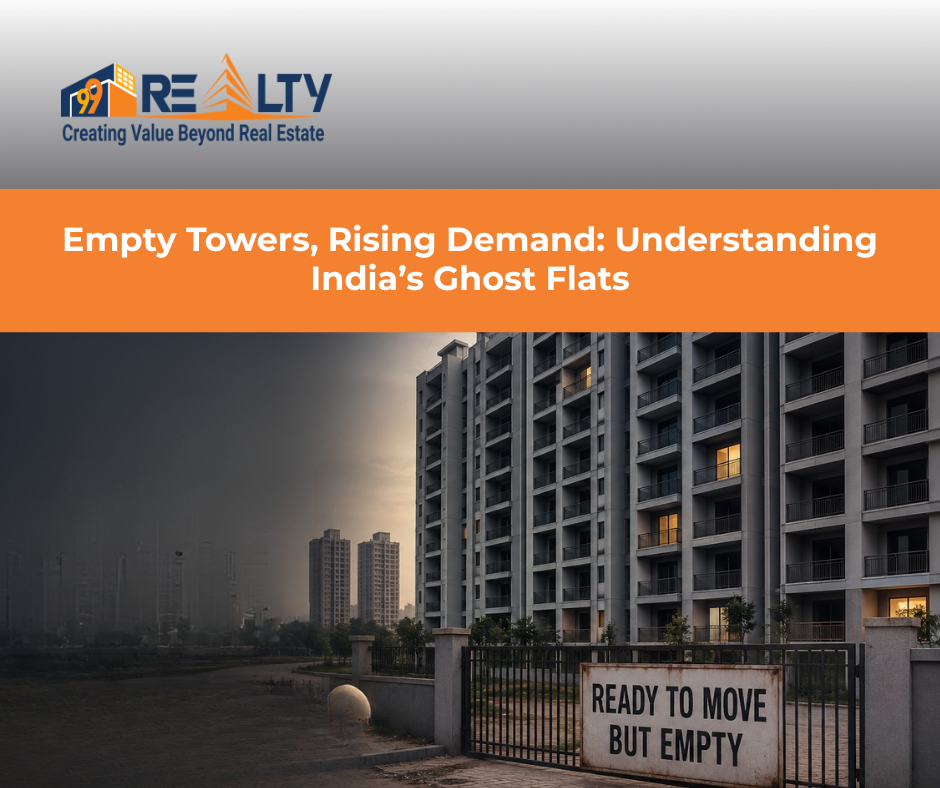
India’s cities are expanding rapidly. New residential towers are reshaping skylines, infrastructure corridors are opening up, and demand for quality housing remains strong. Yet behind this growth lies an unusual contradiction: thousands of completed apartments remain unoccupied even as many families continue searching for suitable homes.
These vacant properties are often described as “ghost flats”—fully built or purchased homes that remain empty for extended periods.
At first, the situation appears difficult to explain. If India needs more housing, why are ready homes sitting vacant?
The answer lies in a combination of affordability, investment behaviour, location, infrastructure, rental economics and regulatory challenges. More importantly, the phenomenon highlights a fundamental reality of real estate: building homes and creating homes people can actually use are two different things.
How to Use Home Loans for Property Investment
What Are Ghost Flats?
“Ghost flat” is an informal term commonly used for completed residential properties that remain unoccupied for a prolonged period.
A development may have hundreds of finished apartments, functioning lifts, landscaped areas and parking facilities, yet only a fraction of the units may actually have residents.
However, an empty flat is not necessarily an unsold flat.
Many vacant properties have already been purchased. Owners may be investors waiting for appreciation, families planning to move in later, second-home buyers, or individuals who do not currently wish to rent out their properties.
In other cases, homes may be physically complete but occupancy is delayed because of infrastructure, connectivity, documentation or approval-related issues.
Why Are Ready Homes Remaining Empty?
There is no single reason behind India’s ghost-flat phenomenon. Several factors can combine to turn a completed residential project into a low-occupancy development.
1. Real Estate as an Investment Asset
For many buyers, property is not purchased primarily for immediate use. It is also a long-term investment.
An investor may purchase an apartment in an emerging locality expecting its value to increase once a metro line, highway, commercial hub or other infrastructure project becomes operational.
If capital appreciation is the main objective, the owner may have little urgency to occupy or rent the property.
When this happens across hundreds of units, a project can achieve strong sales figures without developing an equally strong residential community.
2. The Affordability Mismatch
Perhaps the biggest issue is the difference between housing demand and affordable housing demand.
A city may have thousands of families looking for homes, but that does not mean every available apartment meets their budget.
For example, strong demand for practical two-bedroom homes does not automatically create demand for premium three- or four-bedroom apartments.
The problem, therefore, may not simply be a shortage of housing. It can also be a shortage of the right homes at the right prices and locations.
This explains how vacant premium apartments and strong housing demand can exist in the same city.
Location and Infrastructure Matter
An apartment does not exist in isolation.
People need access to workplaces, schools, hospitals, markets, public transport and essential services. A modern residential tower may offer a clubhouse, gym and landscaped gardens, but those amenities cannot compensate for a difficult daily commute or weak connectivity.
In developing urban corridors, residential construction can sometimes move faster than supporting infrastructure.
Homes may be ready, but roads are still developing. Public transport may be limited. Retail activity may be sparse, and schools or healthcare facilities may still be several kilometres away.
Potential residents then wait for infrastructure to improve, while businesses wait for more residents to arrive.
The result is a cycle of low occupancy.
For homebuyers, this reinforces one of the most important rules of property investment: you are not just buying an apartment; you are buying its location and connectivity.
Legal and Regulatory Challenges
A building that looks complete is not necessarily ready for occupation.
Projects may face delays involving occupancy certificates, documentation, approvals, utilities or other regulatory requirements. Buyers might own their apartments but still face difficulties moving in.
This distinction is particularly important for people purchasing newly completed properties.
Physical completion and legal readiness are not the same thing.
Buyers should therefore verify relevant approvals, project documentation and possession status instead of relying solely on the visible condition of a property.
How Ghost Flats Affect Neighbourhoods
Large-scale vacancy does more than leave apartments unused. It can slow the development of an entire neighbourhood.
Residents create local economic activity. They shop at grocery stores, visit restaurants, use transport, hire services and create demand for schools, pharmacies and other businesses.
Imagine a residential development designed for 2,000 families but occupied by only a few hundred.
Retailers see fewer customers. Commercial spaces take longer to fill. Transport demand remains limited, and the neighbourhood can struggle to develop the vibrant ecosystem originally envisioned.
This creates an occupancy catch-22: people wait for infrastructure and services, while businesses and service providers wait for people.
What Ghost Flats Mean for Property Investors
Ghost flats offer an important lesson for investors: sales numbers alone do not prove end-user demand.
Before investing in a residential project, buyers should ask a simple question:
Who will actually want to live here?
Projects supported by employment centres, connectivity, schools, healthcare, commercial activity and genuine end-user demand may have stronger long-term foundations.
Occupancy itself can therefore be a useful indicator.
A thriving residential community demonstrates something that advertisements and brochures cannot—it shows that people find the location practical enough to build their daily lives around it.
What Should Homebuyers Check Before Buying?
Homebuyers should evaluate the entire ecosystem surrounding a property, not just its floor plan or amenities.
Check actual occupancy in completed phases and visit the project at different times of the day. Examine commute times during peak hours and assess access to schools, hospitals, markets and public transport.
Buyers should also verify the project’s regulatory status and understand whether advertised infrastructure is already operational, under construction or merely proposed.
Future infrastructure can significantly improve property values, but buyers must distinguish between current advantages and future expectations.
A proposed metro station may transform a locality—but until it becomes operational, it remains a future factor rather than a present convenience.
Can Better Rental Markets Reduce Vacant Housing?
Investor-owned properties can potentially add to a city’s rental housing supply.
A stronger and more transparent rental ecosystem could encourage owners to rent vacant apartments instead of keeping them locked for years. This can generate rental income for investors while creating more housing options for people who are not ready to purchase.
Better utilisation of existing homes could therefore become an important part of addressing urban housing needs.
India Needs Homes—and Functioning Neighbourhoods
The ghost-flat phenomenon does not necessarily mean India has built too many homes.
Instead, it highlights a mismatch between housing supply and real-world demand.
Families need homes that match their budgets, workplaces and lifestyles. Investors need properties backed by sustainable demand. Developers need to understand what end-users can realistically afford, while cities need infrastructure that grows alongside residential construction.
A residential tower is ultimately only one part of the equation.
A successful neighbourhood needs homes, people, connectivity, employment, infrastructure and everyday services working together.
For buyers and investors, the lesson is equally clear: look beyond the building. Study the location, occupancy, connectivity, approvals, infrastructure and end-user demand.
Because the true value of real estate is not determined only by how impressive a tower looks—it is shaped by how well people can actually live there.
Frequently Asked Questions
What is a ghost flat in real estate?
A ghost flat is a completed or purchased residential property that remains unoccupied for an extended period. It may be investor-owned, awaiting infrastructure or approvals, or located in an area with limited end-user demand.
Why do apartments remain vacant despite housing demand?
Demand may exist at different prices or locations. High property prices, investor ownership, poor connectivity, infrastructure gaps, limited rental demand and regulatory issues can all contribute to vacancy.
Should buyers avoid projects with low occupancy?
Not necessarily, especially in newly completed developments. However, buyers should understand why occupancy is low and evaluate connectivity, approvals, infrastructure, maintenance and end-user demand before purchasing.
What should investors learn from ghost flats?
Investors should look beyond launch sales and projected appreciation. A property’s long-term potential is closely connected to genuine end-user demand, infrastructure, accessibility and the overall development of the neighbourhood.
Need Help?
Need help evaluating a property or planning your next move in the market?
Reach out to 99 REALTY – your trusted real estate partner for smarter choices.
Subscribe to get updates on our latest posts and market trends.
Related posts



Join The Discussion