

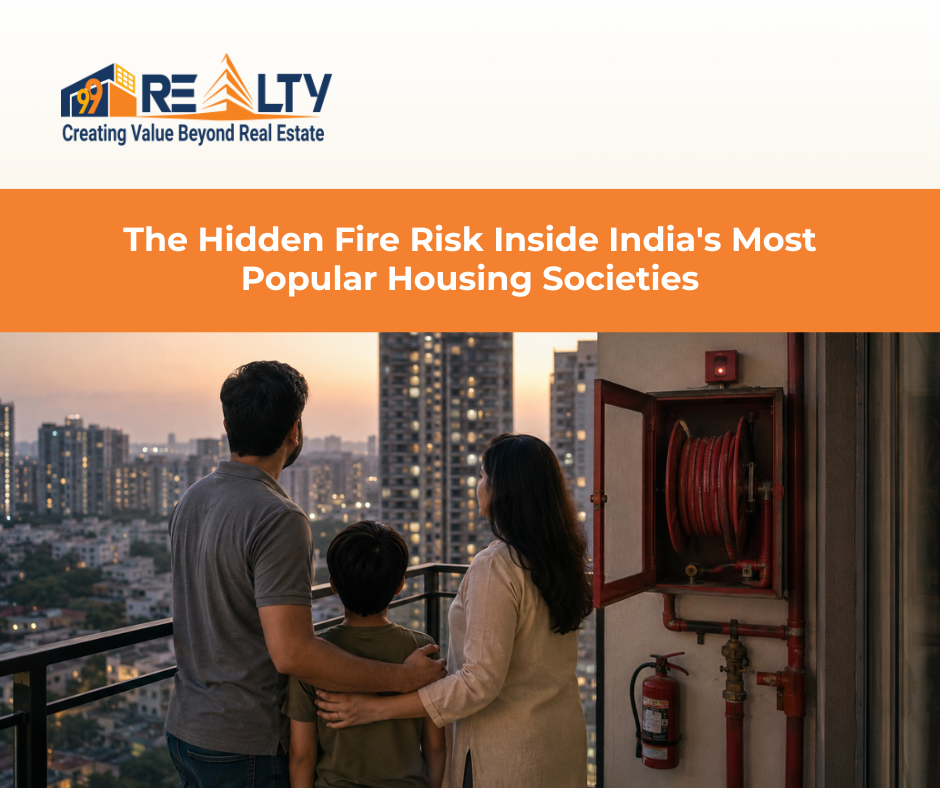
You’ve done the math. Toured the flat. Imagined your family on that balcony on the 14th floor. But there’s one question most Indian homebuyers never think to ask — and it could be the most important question of all: Does this building have a working fire safety system?
If you think that’s a dramatic way to start a property blog, consider what just happened in Ghaziabad recently.
The Audit That Should Wake Up Every Homebuyer
A fire safety audit conducted across high-rise residential societies in Ghaziabad identified 43 housing complexes that failed to meet mandatory fire safety norms. These weren’t obscure, abandoned buildings — they were occupied residential societies. Families were living there. Children were growing up there. And according to fire department inspectors, blocked emergency exits, faulty firefighting systems, non-functional alarms, and poorly maintained safety infrastructure were found across multiple buildings.
Notices have been issued. Timelines have been set. But the real question is — how did it get this far in the first place?
This isn’t just a Ghaziabad problem — it’s becoming an India-wide warning sign. As cities like Noida, Lucknow, Ranchi, and Kolkata race toward rapid vertical expansion, with residential towers now touching 20, 30, even 40 floors, the risks are growing just as fast. Because when urban planning, safety checks, and infrastructure fail to keep pace with this construction boom, a single mistake doesn’t just damage buildings — it can put thousands of lives at risk.
Unlocking the Secrets of Residential vs Commercial Property
The Paper NOC Problem
Here’s something most flat buyers don’t know: getting a fire NOC (No Objection Certificate) during construction is completely different from actually maintaining fire safety once people move in.
“Obtaining fire clearances during construction is only one part of compliance. Regular maintenance of sprinklers, hydrants, smoke detectors, alarms and evacuation systems remains equally important once a project becomes operational.” — Fire Safety Experts, NCR
Developers often tick the box during approval stages. The NOC is acquired, the occupancy certificate is issued, and then… years pass. Sprinkler heads get blocked by paint. Fire exits get locked “for security.” Alarm batteries die and are never replaced. Residents and RWAs assume someone else is handling it. And firefighting systems quietly stop working.
By the time an inspection happens, the building that looked compliant on paper has become a silent hazard.
Flooded Parking Basements Are India’s New Housing Nightmare
Why High-Rises Are Different — And Why That Matters
A fire in a 3-storey building is a very different emergency from a fire on the 22nd floor. When you live in a high-rise, escape routes are limited, fire ladders have height restrictions, and panic can set in fast. In many Indian cities, fire tenders themselves may struggle to reach upper floors effectively.
For context, Ghaziabad currently operates 22 fire tenders for an entire rapidly expanding urban district. Imagine depending on that infrastructure if your 30-floor tower catches fire at 2 AM.
This is why fire safety in high-rise buildings isn’t just a compliance checkbox. And it should be a top priority when you evaluate any property purchase.
The Fire Safety Checklist Every Buyer Must Use
Before you sign a single document or pay a booking amount, go through this checklist. Ask the developer, the RWA, or the site manager. If they can’t answer — that’s an answer in itself.
Fire Safety Buyer’s Checklist By 99Realty
- Fire NOC status: Ask for a copy of the current, valid fire NOC. It must be renewed every 3 years. An expired NOC is a red flag.
- Sprinkler systems: Are automatic sprinklers installed throughout the building — corridors, parking, common areas, not just flats?
- Fire alarms and smoke detectors: Are they functional? When were they last tested?
- Fire hydrants and hose reels: These must be in working order and accessible — not rusted or hidden behind storage.
- Emergency exits: Are stairwell fire exits clearly marked, unlocked, and free of obstructions? If they’re locked “for security” or obstructed that’s a serious violation.
- Fire pump room: Every compliant high-rise must have a dedicated fire pump room with water reserve. Ask to see it.
- Evacuation drill records: Has the society conducted fire drills in the last year? Is there a documented evacuation plan?
- Terrace access: In an emergency, the terrace is a refuge point. Is terrace door access functional and unlocked?
- Fire-rated doors: Apartment entrance doors and stairwell doors should be fire-rated to slow the spread of smoke and flames.
- Maintenance history: Ask the RWA when fire systems were last professionally inspected and serviced.
Red Flags You Should Never Ignore
Some warning signs are easy to spot during your site visit — if you know what to look for:
- Fire extinguishers with expired date tags or empty pressure gauges
- Corridors or stairwells used as storage for boxes, bicycles, or old furniture
- No visible fire exit signage or broken/unlit emergency signs
- A site manager who dismisses your safety questions as “unnecessary concern”
- The developer being vague or evasive about the NOC renewal date
- Absent or visibly faulty fire alarm panels in the lobby
Any single one of these is worth a hard conversation. More than two, and you might want to look elsewhere.
What Homebuyers in Noida, Ranchi, and Emerging Cities Should Know
The Ghaziabad audit is a mirror for any Indian city experiencing rapid vertical growth. Whether you’re looking at a new project in Noida’s Sector 150, a high-rise society in Lucknow’s Gomti Nagar, or an upcoming tower project in Ranchi or Dhanbad — the same rules apply, and enforcement varies wildly.
In Tier 2 cities especially, fire safety infrastructure may be less developed, local fire departments may have fewer resources, and buyer awareness is lower. This makes it even more critical to do your own due diligence rather than relying on authorities to catch problems before they affect you.
What RERA Says (And What It Doesn’t)
RERA mandates that developers disclose all approvals, including fire NOCs, on the project registration portal. Before buying any RERA-registered project, check the project’s RERA registration page for your state — all fire clearances should be listed there. If they’re not uploaded, that’s a non-compliance issue you can raise.
However, RERA doesn’t govern post-handover maintenance. Once the society is formed and handed over to the RWA, the responsibility shifts. This is why being active in your RWA after purchase isn’t just about parking disputes — it’s about your safety.
A Final Word for the Smart Buyer
India’s real estate market is growing faster than ever. More families are moving into apartments. More towers are being built. That momentum is exciting — but it also means more people are depending on systems that must work when it matters most.
Fire safety isn’t glamorous. It doesn’t show up in a brochure alongside the infinity pool and the smart home features. But it is the difference between a home and a hazard.
Ask the questions. Request the documents. Do the walkthrough with eyes open. Because an informed buyer isn’t just a smarter buyer — they’re a safer one.
Need Help?
Need help evaluating a property or planning your next move in the market?
Reach out to 99 REALTY – your trusted real estate partner for smarter choices.
Subscribe to get updates on our latest posts and market trends.


Join The Discussion