

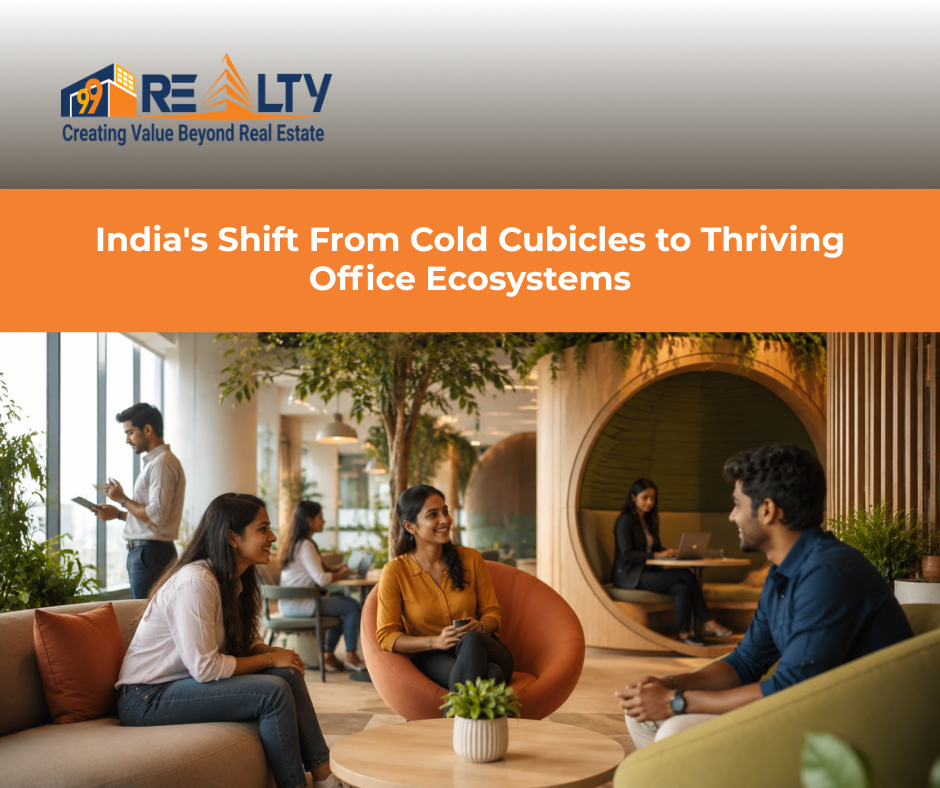
Walk into a premium office development in Mumbai, Bengaluru, or Delhi NCR today and you’ll notice something different. The cubicle farms are gone. In their place: landscaped courtyards catching afternoon light, café counters humming with conversation, wellness lounges tucked between collaboration pods, and air systems so advanced they’re managed by artificial intelligence. This isn’t a tech campus in Silicon Valley. This is the new face of Indian commercial real estate — and it’s rewriting every rulebook the industry once swore by.
The End of “Just an Office”
For decades, Indian corporate real estate operated on a simple, transactional logic: provide four walls, reliable power, and enough desks to seat the headcount. Location mattered. Square footage mattered. Everything else was noise.
That logic is now obsolete.
The post-pandemic workforce didn’t just change where people work — it fundamentally changed why they agree to show up at all. Employees today carry a quiet but powerful question into every lease decision their employer makes: Is this place worth my commute? Developers who understand that question are winning. Those still selling square footage are quietly getting left behind.
India’s commercial real estate sector is in the middle of a genuine paradigm shift — from transactional infrastructure to experience-led ecosystems. And the developers who are moving fastest are the ones who saw this coming before the pandemic forced everyone else to catch up.
Unlocking the Secrets of Residential vs Commercial Property
What “Experience-Led” Actually Means
The phrase gets thrown around a lot. But what does an experience-led workplace actually look like on the ground?
It means biophilic design — greenery, natural light, and open-air zones that don’t feel like afterthoughts bolted onto a glass tower. It means collaborative infrastructure: breakout zones, open interaction spaces, and community areas that encourage the kind of spontaneous conversation that Slack channels simply cannot replicate. It means hospitality-grade conveniences — proper cafés, not sad vending machines — and recreational zones that signal to employees that their employer actually thought about their day beyond the hours between 9 and 6.
And increasingly, it means something less visible but arguably more important: the air you breathe.
Indoor environmental quality — long ignored in the rush to maximise leasable area — has emerged as one of the defining differentiators in premium commercial development. The data is unambiguous: poor air quality degrades cognitive performance, increases fatigue, and directly impacts workplace productivity. Developers building for the next decade know this. Which is why the most forward-thinking projects are now integrating AI-powered autonomous air infrastructure, advanced ventilation systems, and smart building management technologies that monitor and optimise the indoor environment in real time.
Superb Realty, for instance, has partnered with AI firm Praan to integrate intelligent air infrastructure across over one million square feet of development, including their flagship commercial project Superb Altura. It’s a significant bet — and a signal of where the premium segment is heading.
The Talent Economy Is Driving the Real Estate Economy
Here’s the underlying logic that every serious developer and corporate occupier now has to reckon with: real estate decisions are talent decisions.
In a competitive hiring market, the quality of a workplace is a recruitment and retention tool. Companies that offer employees environments where they feel energised, comfortable, and part of a genuine community have a measurable edge. Those that don’t are fighting with one hand tied behind their backs — offering market salaries from offices that feel like they were designed by someone who’d never met an employee.
Transcon Developers’ Ramdev Plaza encapsulates this shift cleanly. The project has been conceived not as a conventional office development, but as an integrated ecosystem — contemporary workspaces, strong connectivity, thoughtfully planned layouts, dedicated recreational zones, and lifestyle-driven conveniences all woven into a coherent experience. The goal isn’t just to house a business. It’s to make the people inside that business actually want to be there.
Sustainability Is No Longer Optional
Woven through this transformation is another trend that is rapidly moving from differentiator to baseline expectation: sustainability.
Green zones, energy-efficient systems, advanced air filtration, and smart building management aren’t just wellness features — they’re operational efficiency plays. Buildings that consume less, perform smarter, and create healthier environments cost less to run and are easier to lease. As ESG commitments become non-negotiable for multinational occupiers, the buildings that can demonstrate measurable environmental credentials will be the ones that attract — and keep — the best tenants.
This is particularly relevant for Indian cities scaling up their commercial stock. Noida, Hyderabad, and Pune are adding millions of square feet every year. The question isn’t whether these markets will grow — they will. The question is whether the product being built will be fit for the occupiers of 2030, or whether developers are locking themselves into assets that will age badly.
What This Means for India’s Tier-2 and Emerging Markets
The experience-led revolution is well underway in India’s Tier-1 commercial hubs. But the more interesting question — and the bigger opportunity — lies in what happens next in India’s emerging real estate markets.
Cities like Ranchi, Lucknow, Bhubaneshwar and Kolkata are seeing growing appetite from businesses looking beyond the congestion and premium pricing of metro markets. As remote and hybrid work models normalise distributed office footprints, the demand for quality commercial infrastructure in Tier-2 cities is no longer theoretical. It’s active.
The developers who bring experience-led design principles to these markets — rather than building yesterday’s metro product at a discounted rate — will define what commercial real estate looks like in India’s next wave of growth cities. The opportunity is significant. The bar being set is high.
SOHO Explained: Why Small Office Home Office (SOHO) is the Next Big Trend in India
The Bottom Line
India’s commercial real estate sector is not experiencing a cosmetic makeover. It is undergoing a structural rethink of what an office is, what it is for, and who it needs to serve.
The cubicle is not coming back. The office as a warehouse for human productivity is over. What replaces it — if developers and occupiers make the right decisions — is something considerably more compelling: a space where people work better, feel better, and genuinely want to be.
That shift isn’t just good for employees. It’s good for asset values, occupier retention, and the long-term health of India’s commercial property market.
The future of Indian real estate isn’t being built in square feet. It’s being built in experiences.
Need Help?
Need help evaluating a property or planning your next move in the market?
Reach out to 99 REALTY – your trusted real estate partner for smarter choices.
Subscribe to get updates on our latest posts and market trends.


Join The Discussion